.jpg)
















The GST Return Filing Course That Could Save Your Career







Summary
A GST return filing course teaches you to register, file, and reconcile GST returns (GSTR-1, GSTR-3B, GSTR-9) using the government portal and software like Tally. It’s a 4–12 week practical program that turns a GST fresher into a job-ready GST professional; no CA degree required.
You’ve got a degree. You’ve got a polished resume. What you don’t have is a callback.
Sound familiar? Here’s the uncomfortable truth: in 2026, “B.Com with basic Excel knowledge” is not a skill anymore. It’s the bare minimum. Every second candidate in the interview room has that. What separates the ones who get hired from the ones who keep waiting is one thing recruiters actually search for on LinkedIn: GST.
India now has over 1.53 crore active GST-registered taxpayers, and every single one of them has to file returns monthly, quarterly, or annually. That’s not a small compliance requirement. That’s an entire job market hiding in plain sight, and most students walk right past it.
Let’s fix that.
Table of Contents
What Is a GST Return Filing Course?
A GST return filing course is a practical training program that teaches you how to manage Goods and Services Tax compliance for a real business, from registration to return filing to reconciliation.
Unlike a theory-heavy college module, a good course puts you inside a simulated (or live) GST portal so you actually file returns, not just read about them. Core topics usually include:
- GST registration when it’s mandatory, how to apply, and how GSTINs work
- GSTR-1 outward supply/sales return, typically due on the 11th of the next month (13th for quarterly filers)
- GSTR-3B the summary monthly return, typically due the 20th (22nd/24th for quarterly filers, depending on state)
- Input Tax Credit (ITC): how businesses claim credit for GST already paid on purchases
- E-way bills and e-invoicing for goods movement and B2B compliance
- Annual returns and reconciliation GSTR-9, matching books with portal data
In short: it’s the difference between knowing what GST is and being the person a company trusts to file it correctly, on time, every month.
Why Does a GST Filing Course Matter for Your Career Right Now?
Because the demand is real, and it’s not slowing down. A few numbers worth sitting with:
- 1.2+ crore businesses are registered under GST across India as of 2026 every one of them needs someone handling filings.
- Entry-level GST professionals start between ₹2.5–4 LPA, moving toward ₹7 LPA and above within 2–3 years of hands-on experience, according to industry salary data.
- Big 4 firms and large corporates have reportedly offered 25–30% pay bumps to existing staff who move into dedicated GST/tax compliance teams.
- Tax accountants who handle GST, TDS, and reconciliation independently often out-earn generalist accountants doing pure data entry by a wide margin.
Here’s the part nobody tells you at college placement talks: companies aren’t just hiring Chartered Accountants for GST work. They’re hiring GST executives, compliance associates, and tax assistant roles built exactly for freshers and career switchers who’ve done a focused GST professional certification.
Who Should Actually Take a GST Certification Course?
If any of these sound like you, keep reading:
- Final-year or recent B.Com/BBA graduates who feel their degree taught them theory but not “how a real GST return actually looks”
- Non-commerce graduates (BA, BSc, even engineers) pivoting into finance and accounting roles
- Working professionals in accounts, admin, or operations who want to move into a taxation-focused role
- Career switchers: ex-teachers, ex-retail staff, homemakers returning to work who want a practical, short-duration path back into employment
- Small business owners and freelancers who currently pay someone else to file their own GST returns
You don’t need a CA qualification to file GST returns for a company. You need to actually know how to do it, and that’s exactly what a GST certification course is built to teach.
Same Degree, Two Very Different Job Offers
Picture two B.Com graduates, same college, same year, same CGPA.
Graduate A applies to 40 accounting job openings with just her degree and a generic resume. She gets 3 callbacks in two months, mostly for data-entry roles paying ₹12,000–15,000/month.
Graduate B spends 6 weeks doing a GST return filing course alongside his final semester. His resume now says “filed 50+ simulated GST returns, handled GSTR-1/3B reconciliation, worked with e-way bills.” He gets shortlisted for compliance and tax-assistant roles paying ₹20,000–25,000/month starting, and within 18 months, he’s handling GST filings independently for multiple client accounts.
| Factors | Without GST Skills | With GST Certification | Resume line | “Basic accounting knowledge” | “GST return filing (GSTR-1, 3B, 9), ITC reconciliation” | Typical starting role | Data entry / back-office | GST executive/tax assistant | Interview confidence | Can explain theory | Can demo actual filings | Growth path | Slow, generalist | Specialist track, faster raises |
|---|
Same degree. Different door.
Why Learn GST Filing With ICA Edu Skills?
If you’re going to invest weeks into a GST professional certification, it should actually mirror what happens on the job, not just cover slides and PDFs.
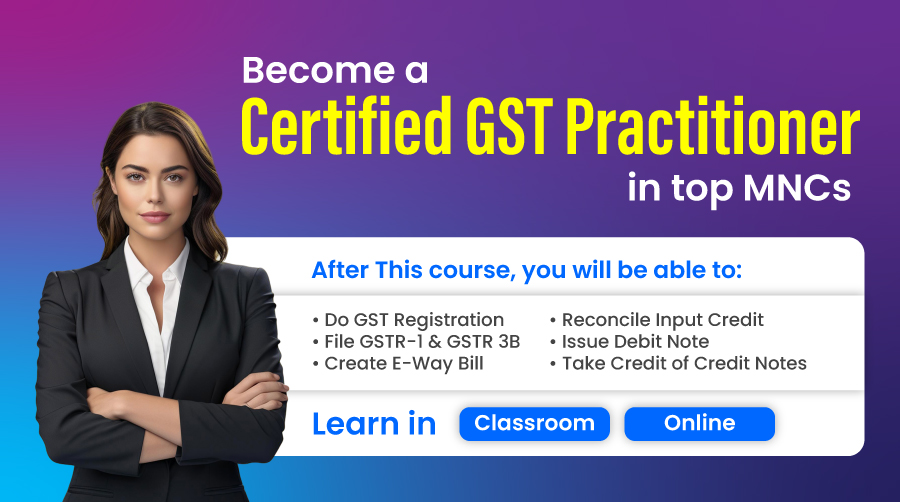
ICA Edu Skills’ GST Certification Course is built around the Simulation platform, where you file GST and ITR in simulated live scenarios over 200 practical exercises instead of memorizing return formats. The course covers registration, GSTR filing, reconciliation, and e-way bills, and leads to a Certified GST Professional credential jointly issued with the NSDC, giving it recognised, government-aligned weight on your resume.
Course graduates have gone on to compliance and finance roles at organisations including PwC, HCL, and other mid-to-large corporates proof that recruiters do respond to a resume that shows applied GST skills, not just a course completion certificate. If you’re weighing your next move degree first, job hunt next, or skill-up now a focused GST certification course is one of the fastest ways to make your resume say something a recruiter actually wants to read.
Few GST related topics for your knowledge
- Place Of Supply In GST: Importance, Meaning & Types
- 10 Essential Topics Covered In GST Courses
- How To File GSTR 1: Process, Deadlines & Penalties Explained
- GST Registration Process: Steps, Requirements, Status Checks, Benefits
- Structure of GST in India: Types, Rates, 4-Tiers Tax
- Top 50 GST Interview Questions & Answers
The Bottom Line
A GST return filing course won’t magically hand you a job. But it does something more useful: it turns “I have a degree” into “I can actually do the work,” and that’s what gets you past the resume filter and into the interview room.
With over 1.5 crore GST taxpayers needing regular compliance support, this isn’t a shrinking niche. It’s one of the steadier, more in-demand corners of India’s job market, and it’s genuinely open to freshers, non-commerce grads, and career switchers alike.
If you’ve been stuck deciding what to upskill in next, this is about as low-risk and high-return a bet as it gets. Explore a GST certification course, see the syllabus, and decide for yourself if it fits where you want to be a year from now.
Frequently Asked Questions
1. Is a GST return filing course useful for freshers with no accounting background?
Yes. Most GST return filing courses start from the basics: GST concepts, registration, invoicing before moving to live return filing. A commerce background helps but isn’t mandatory; non-commerce graduates complete it successfully too.
2. How long does a GST certification course take to complete?
Most GST certification courses run 4–12 weeks, depending on whether you choose a stand-alone GST module or a combined GST + Tally + Direct Tax program. Practical, project-based courses may take slightly longer than theory-only ones.
3. Can I file GST returns for a company without a CA qualification?
Yes. You don’t need to be a Chartered Accountant to work as a GST executive or compliance associate. A GST professional certification qualifies you for these roles; only signing statutory audits legally requires a CA.
4. What salary can I expect after a GST filing course?
Entry-level GST professionals in India typically start around ₹2.5–4 LPA, rising toward ₹7 LPA+ with 2–3 years of hands-on filing experience, higher still at metro-based firms or MNCs, per industry salary data.
5. Is GST applicable to coaching institutes and online courses?
Yes. Private coaching institutes and EdTech platforms are taxable service providers and charge 18% GST (SAC 999293) once annual turnover crosses ₹20 lakh, unlike recognised schools and colleges, which are GST-exempt.

- The GST Return Filing Course That Could Save Your Career - September 5, 2026
- Source List in SAP MM: Why Every Interviewer Asks This - August 28, 2026
- Best English Speaking Course: Why Fluency Beats Your Degree - August 21, 2026