.jpg)

















Source List in SAP MM: Why Every Interviewer Asks This







Summary
A source list in SAP MM is a master data record that lists the approved vendors, plants, or outline agreements allowed to supply a specific material to a specific plant during a defined validity period. Maintained through T-code ME01, it controls and automates source determination for purchase requisitions, purchase orders, and MRP runs.
Picture this. You’re three rounds deep into an SAP MM interview. You’ve nailed the theory on purchase orders, you know your MIGO from your MIRO, and you’re feeling good.
Then the interviewer leans in and asks: “Walk me through how a source list works, and why would a plant use it instead of just picking any vendor?”
Silence.
If that scenario makes you a little uneasy, you’re not alone. Source list is one of those SAP MM topics that looks small on paper but shows up in almost every interview, every real procurement process, and every SAP MM certification syllabus. Freshers skim past it because it sounds like “just another config screen.” Recruiters, on the other hand, use it to instantly separate candidates who’ve only watched tutorial videos from candidates who actually understand how procurement runs on the ground.
This post breaks down exactly what a source list in SAP MM is, how it works, where it fits into your career, and how to actually get comfortable with it, not just memorise it.
Table of Contents
- What Is a Source List in SAP MM?
- Why Does the Source List Actually Matter in Procurement?
- What Fields Make Up a Source List Entry?
- What Is the T-Code for Source List in SAP MM?
- How Source List Entries Get Created Two Ways
- A Real-World Scenario
- Source List vs Purchasing Info Record vs Quota Arrangement
- Why This “Small” Topic Can Make or Break Your SAP MM Career
- Common Mistakes Freshers Make With Source List
- Where Can You Actually Practice This, Not Just Read About It?
- The Bottom Line
- Frequently Asked Questions
What Is a Source List in SAP MM?
A source list in SAP MM is a plant-level master data object that defines who is allowed to supply a material. Think of it as an approved-vendor gatekeeper sitting between “we need this material” and “let’s create a purchase order.”
For every material-plant combination, the source list can store:
- One or more approved vendors, plants (for stock transfers), or outline agreements
- A validity period (start date and end date) for each source
- Whether a source is fixed (system should prefer it automatically)
- Whether a source is blocked (never allowed, even if it exists in the system)
- Whether the entry is relevant for MRP (so the system can auto-assign it during planning runs)
In simple terms: without a source list, SAP will let a buyer create a purchase order with almost any vendor in the system. With a source list active, the system enforces “only these vendors, only during this period,” which is exactly how real purchasing departments operate.
Rule the Market with Professional SAP Training |
|||
| SAP Certification Courses | |||
| Explore All SAP Courses | |||
| SAP FICO Course | SAP MM Course | SAP PP Course | SAP SD Course | |||
Why Does the Source List Actually Matter in Procurement?
This is the part most tutorials skip, and it’s exactly what interviewers probe. A source list isn’t just a data entry screen it solves real business problems:
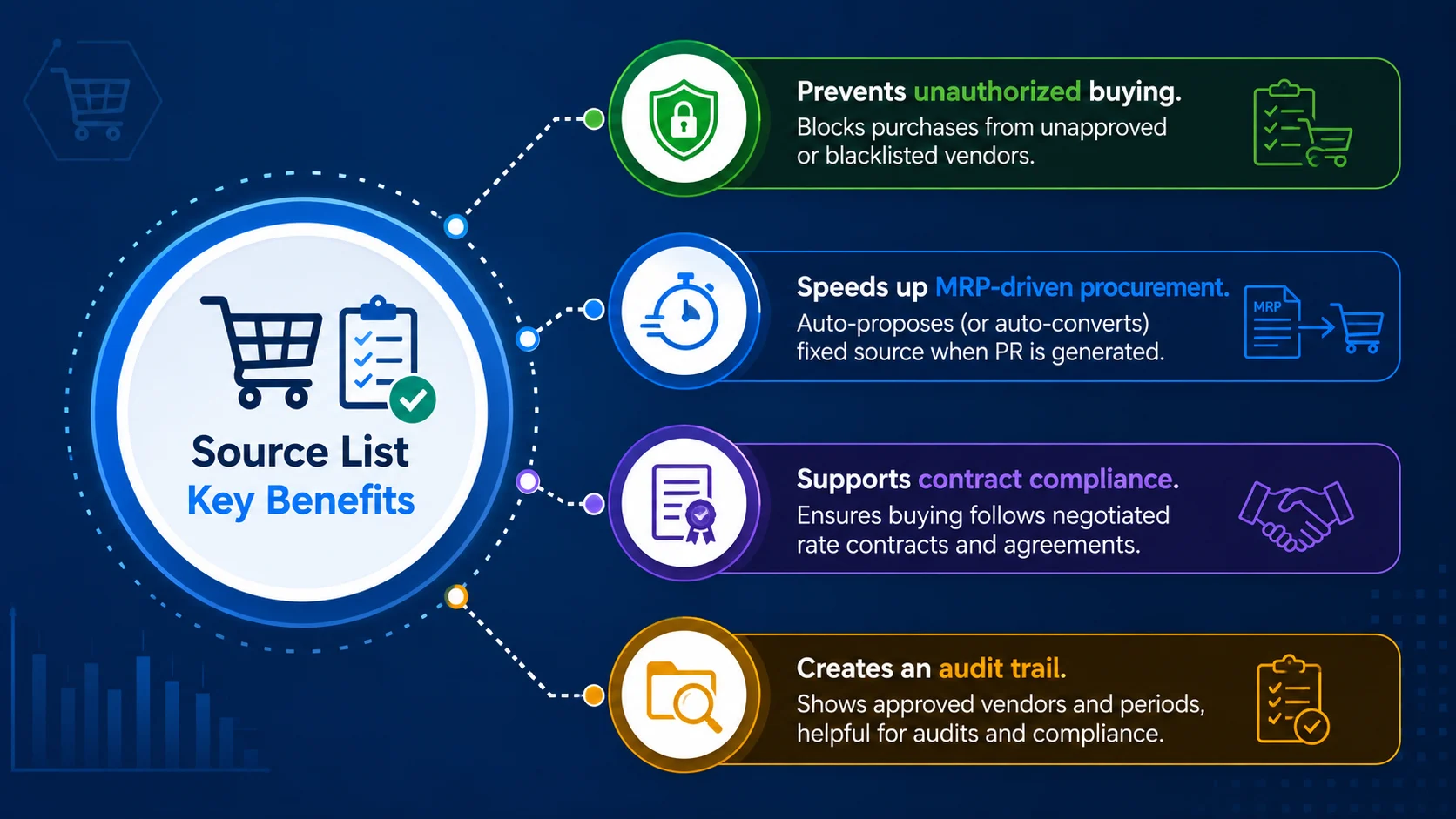
- Prevents unauthorized buying. A junior buyer can’t accidentally raise a PO with an unapproved or blacklisted vendor.
- Speeds up MRP-driven procurement. When MRP runs and a purchase requisition is generated, the system can automatically propose (or even auto-convert to a PO) the fixed source, with no manual vendor search needed.
- Supports contract compliance. Companies negotiate rate contracts and scheduling agreements with specific vendors. The source list makes sure procurement actually follows those agreements instead of buying off-contract.
- Creates an audit trail. Auditors and category managers can instantly see which vendors were “legally” allowed to supply a material during any given period, useful during vendor disputes or compliance checks.
What Fields Make Up a Source List Entry?
FieldWhat It DoesMaterialThe material for which the source is being definedPlantThe receiving plantSource of SupplyVendor, supplying plant, or outline agreement numberValid From / Valid ToThe date range during which this source is approvedFixed IndicatorMarks this as the preferred/default source for the periodBlock IndicatorDisqualifies this source, even if a record existsMRP Indicator (1/2)Makes the entry usable during automatic MRP source determination
| Field | What It Does |
|---|---|
| Material | The material for which the source is being defined |
| Plant | The receiving plant |
| Source of Supply | Vendor, supplying plant, or outline agreement number |
| Valid From / Valid To | The date range during which this source is approved |
| Fixed Indicator | Marks this as the preferred/default source for the period |
| Block Indicator | Disqualifies this source, even if a record exists |
| MRP Indicator (1/2) | Makes the entry usable during automatic MRP source determination |
Only one source can carry the fixed indicator per material-plant-period, but multiple valid (non-fixed) sources can co-exist, useful when a plant is allowed to buy from two or three approved vendors but has one preferred choice.
What Is the T-Code for Source List in SAP MM?
This is one of the most searched questions around this topic, and it’s a common rapid-fire interview question too:
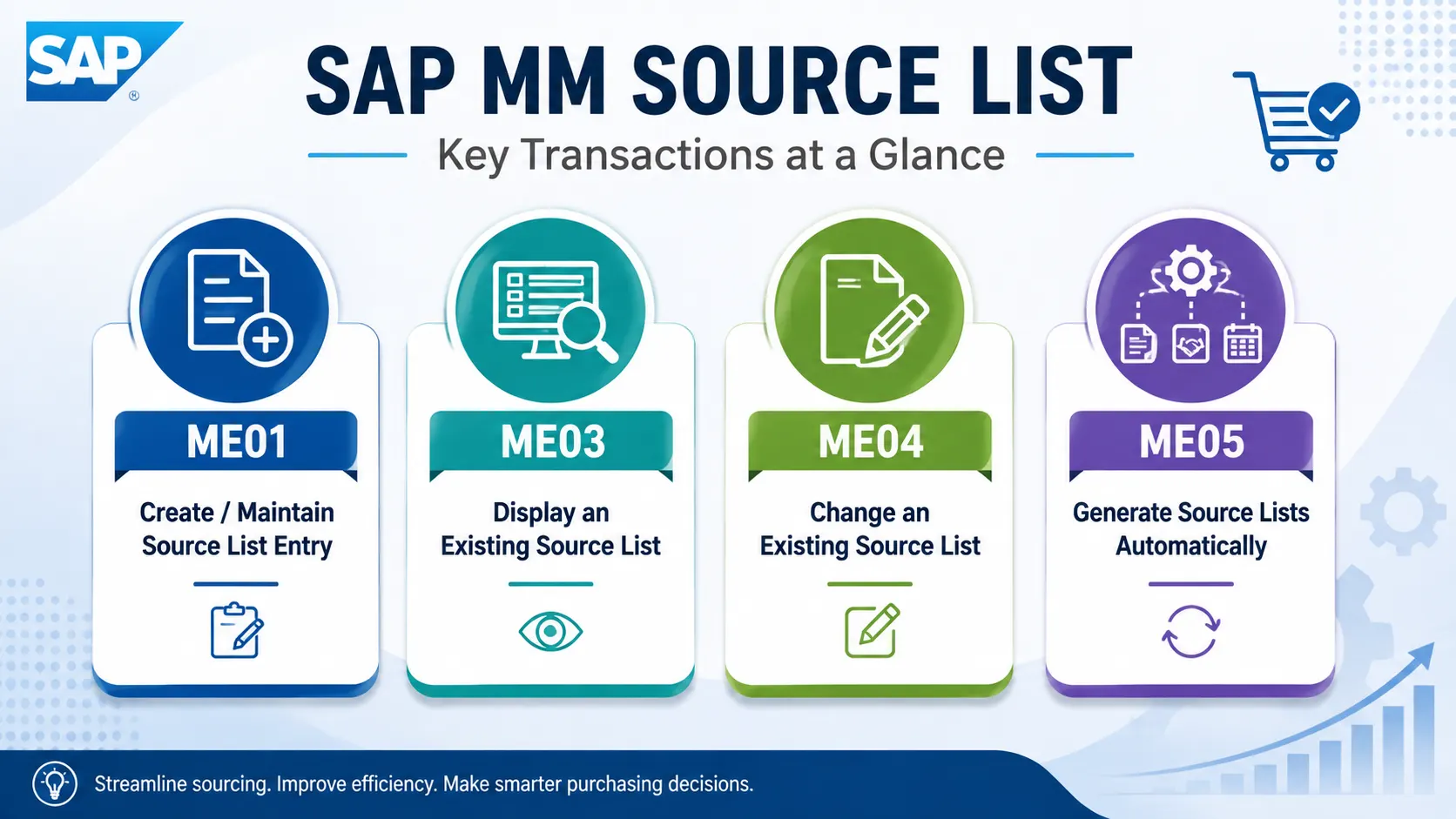
- ME01 – Create/Maintain a source list entry
- ME03 – Display an existing source list
- ME04 – Change an existing source list
- ME05 – Generate source lists automatically from existing purchasing info records, contracts, or scheduling agreements
In S/4HANA, the same functionality is also available through the Manage Source Lists Fiori app; the underlying logic hasn’t changed, only the interface has.
How Source List Entries Get Created Two Ways
Manually (ME01): A buyer or MM consultant enters the material, plant, vendor, and validity dates by hand. This is common when a new vendor is onboarded or a fresh contract is signed.
Automatically (ME05): Instead of typing hundreds of entries one by one, ME05 scans existing info records, contracts, and scheduling agreements for a plant or material range and generates source list entries in bulk. In real projects with thousands of materials, this is the method actually used; manual entry through ME01 is mostly for exceptions and corrections.
A Real-World Scenario
Here’s a situation that plays out often on the shop floor of manufacturing companies using SAP:
A plant’s MRP run generates a purchase requisition for a raw material that’s running low. The material has two vendors in the system: Vendor A (a long-term, quality-approved supplier) and Vendor B (added temporarily for a one-time emergency buy last year).
Without a source list, the MRP run, or the buyer could just as easily pick Vendor B, whose contract expired and whose material once failed a quality check.
With an active source list, Vendor B’s entry has already lapsed (its Valid To date is in the past) or is marked blocked. The system automatically routes the requisition to Vendor A instead, without anyone manually double-checking vendor history. That’s the difference between a process that runs on tribal knowledge and one that runs on system control, and it’s exactly the kind of scenario interviewers like to describe as a case study.

Source List vs Purchasing Info Record vs Quota Arrangement
These three get mixed up constantly by freshers, and clearing up the difference is often the single question that separates a confident SAP MM candidate from a shaky one.
ObjectWhat It Actually ControlsSource ListWhich vendors/plants are allowed to supply a material, and whenPurchasing Info RecordVendor-specific details like price, lead time, and vendor’s material number; no eligibility controlQuota ArrangementHow much of the total requirement each approved vendor gets, expressed as a percentage split
| Object | What It Actually Controls |
|---|---|
| Source List | Which vendors/plants are allowed to supply a material, and when |
| Purchasing Info Record | Vendor-specific details like price, lead time, and vendor’s material number; no eligibility control |
| Quota Arrangement | How much of the total requirement each approved vendor gets, expressed as a percentage split |
A simple way to remember it: the info record tells you the terms, the source list tells you who’s allowed to sell, and the quota arrangement tells you how the order gets divided when more than one vendor is approved.
Why This “Small” Topic Can Make or Break Your SAP MM Career
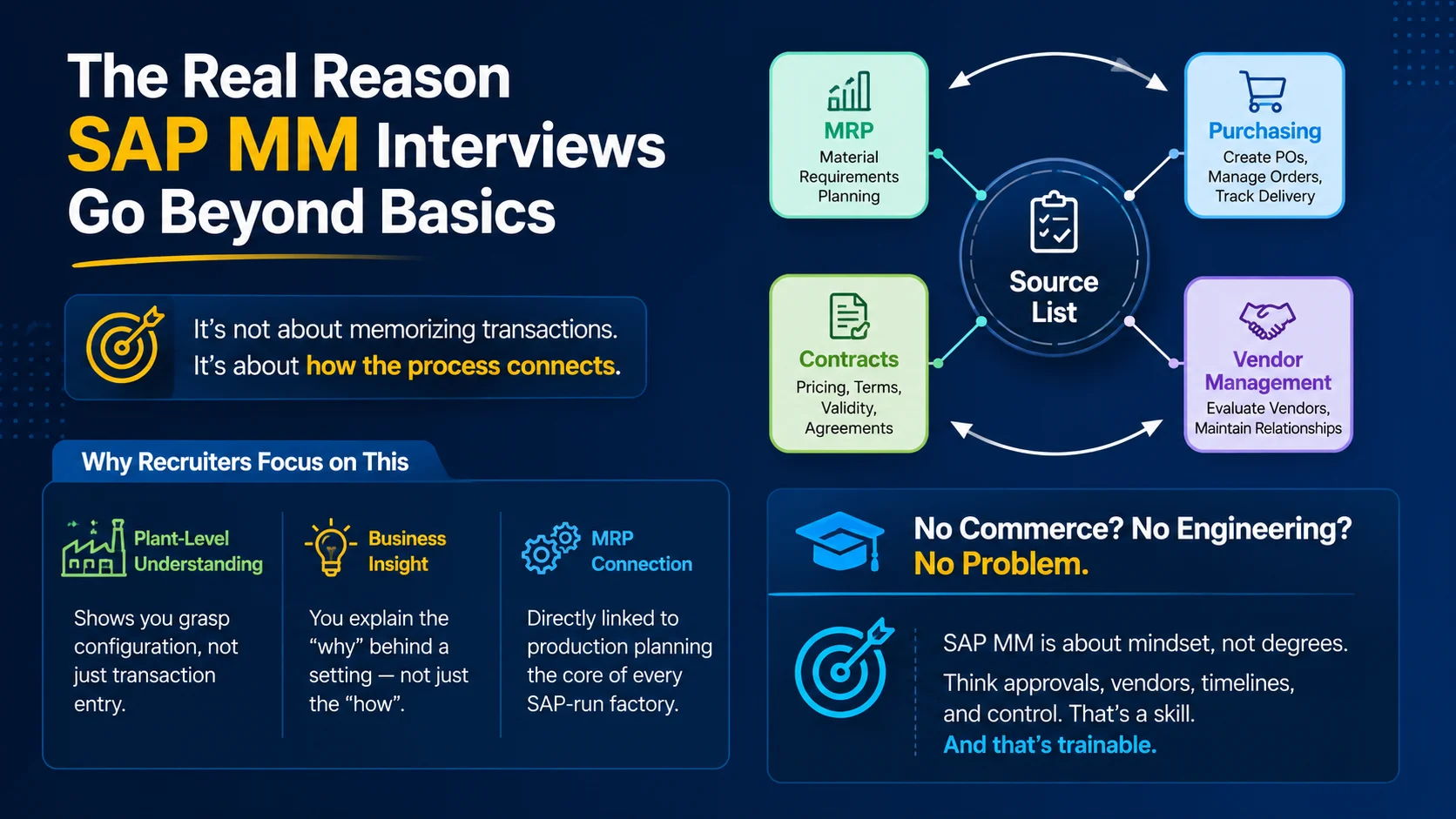
Here’s the honest career insight most blog posts won’t give you: SAP MM interviews rarely fail on the big, obvious topics like purchase order creation or goods receipt. They fail on connector topics like source list, where the interviewer is really testing whether you understand how procurement processes actually flow together MRP, purchasing, contracts, and vendor management- all touching the same master data object.
Recruiters at manufacturing, FMCG, pharma, and retail companies specifically ask about source list because:
- It shows you understand plant-level configuration, not just transaction entry
- It reveals whether you can explain the business reason behind a technical setting a skill that separates a support consultant from someone who can actually sit with a client and design a process
- It’s directly tied to MRP, which is the backbone of production planning in almost every SAP-run factory in India
If you’re a fresher wondering whether SAP MM is worth learning without a commerce or engineering background, this is your answer. SAP MM doesn’t require you to be a finance graduate. It requires you to think like a procurement person: approvals, vendors, timelines, and control. That mindset can be trained.
Common Mistakes Freshers Make With Source List
- Confusing it with the info record and assuming it stores pricing; it doesn’t.
- Forgetting the MRP indicator, then wondering why MRP isn’t auto-proposing a source during a live demo.
- Not checking the source list requirement flag at the plant/material level, and being confused about why the system sometimes enforces it and sometimes doesn’t.
- Assuming only one vendor can exist per material; multiple valid, non-fixed sources are completely normal.
None of these are hard to fix. They just need someone to actually show you the transaction screens instead of describing them in a slide.
Where Can You Actually Practice This, Not Just Read About It?
Reading about ME01 and ME05 only gets you halfway. The real learning happens when you sit inside a live SAP MM system, create a source list for a material yourself, deliberately block a vendor, run MRP, and watch the system behave differently.
That’s the gap ICA Edu Skills’ SAP MM course is built to close. Instead of theory-only sessions, learners get direct time inside a working SAP environment to configure and test master data objects like source lists, info records, and quota arrangements the same objects that come up in interviews and on the job. The course is aligned with NSDC standards, and beyond the SAP modules themselves, every batch includes monthly mock interviews and group discussions, so you’re not just learning SAP; you’re learning to explain SAP under interview pressure, which is where most freshers actually lose marks.
If source list, MRP, and procurement workflows sound like the kind of logic you’d enjoy working with daily, that’s usually a good sign SAP MM is the right specialization to pursue.
Few SAP related topics for your knowledge
- Accounts Receivable Process In SAP:A Step-by-Step Process
- SAP FICO Enterprise Structure: A Comprehensive Guide
- Accounts Payable Process in SAP: Step by Step Guide
- Vendor Reconciliation in SAP: Definition, Steps, Scenario, Advantages
- SAP Order To Cash Process: Optimizing Financial Flows
- 25+ SAP MM Interview Questions & Answers: Cheat Sheet You Need Today
The Bottom Line
A source list in SAP MM might look like a small configuration screen, but it sits at the intersection of vendor management, MRP, and procurement compliance, which is exactly why it keeps showing up in interviews and on the job. Understanding why it exists, not just how to create one, is what turns a textbook answer into a confident one.
If you’re serious about a career in SAP MM, don’t stop at reading; get inside a system, create a few source list entries yourself, and see how the logic actually plays out. And if you’d like structured, guided practice instead of figuring it out alone, ICA Edu Skills’ SAP MM course is worth exploring.
Frequently Asked Questions
1. What is a source list in SAP MM?
A source list in SAP MM is a plant-specific master record (T-code ME01) that defines which vendors, plants, or outline agreements are approved to supply a material during a set validity period. It controls source determination for purchase requisitions, POs, and MRP-generated orders.
2. What is the T-code for source list in SAP MM?
The main T-codes are ME01 (create/maintain), ME03 (display), ME04 (change), and ME05 (generate source lists automatically from existing info records, contracts, or scheduling agreements for a plant or material).
3. What is the difference between a source list and a purchasing info record?
A purchasing info record stores vendor-specific data like price, lead time, and vendor material number. A source list doesn’t store pricing; it simply says which vendor(s) are valid sources for a material at a plant, and whether that source is fixed, blocked, or MRP-relevant.
4. Is maintaining a source list mandatory in SAP MM?
Not by default. It becomes mandatory when the “source list requirement” indicator is switched on at the plant or material level. Once active, the system won’t let a PR convert to a PO until a valid, unblocked source list entry exists for that material-plant combination.
5. How do you create a source list automatically in SAP?
Use T-code ME05. It scans existing purchasing info records, contracts, and scheduling agreements for a material or plant and auto-generates source list entries from them, saving you manual entry for every material-vendor combination.

- Will Learning Advanced Excel Actually Help Me Get a Job? - October 9, 2026
- Skill Development Institute in India - September 26, 2026
- Master Data in SAP PP: The Skill Recruiters Test First - September 18, 2026