.jpg)


















Movement Types in SAP MM: What They Are, Why They Matter, and How to Master Them







Quick Answer
Movement types in SAP MM are three-digit numeric codes used in SAP’s Materials Management module to categorize and record every inventory transaction from goods receipts and issues to stock transfers and returns. They control how stock levels, accounting entries, and inventory documents are updated in real time. Common examples include 101 (goods receipt), 261 (goods issue to production), and 311 (stock transfer).
You’ve been studying SAP for weeks, but this one concept still doesn’t click.
Let’s be honest. You’ve watched the YouTube tutorials. You’ve read the PDFs. You’ve even joined a few SAP groups on WhatsApp. But the moment someone says “movement type 601” or “reversal with movement type 102,” your brain does that thing where it just… goes blank. You’re not alone.
Movement types in SAP MM are one of the first things that confuse beginners, and one of the first things that impress employers when you actually know them well.
This guide is going to fix that. In plain English. With real examples. No jargon walls. Let’s get into it.
Table of Contents
- What Are Movement Types in SAP MM?
- Why Do Movement Types Matter So Much?
- The Most Important Movement Types in SAP MM
- What Happens When You Post a Movement Type?
- Movement Type Configuration: What Does It Control?
- How ICA Edu Skills Helps You Actually Learn SAP MM
- Common Mistakes Beginners Make with Movement Types
- Movement Types in SAP MM: Quick-Reference Sheet
- Conclusion
- Frequently Asked Questions
What Are Movement Types in SAP MM?
Movement types are three-digit codes in SAP’s Materials Management (MM) module that tell the system what kind of inventory transaction is happening.
Think of them as labels. Every time stock moves, whether it arrives from a vendor, gets issued to a factory floor, is transferred between warehouses, or gets returned, SAP needs to know the reason and direction of that movement. That’s exactly what a movement type communicates.
Without movement types, SAP wouldn’t know:
- Whether to increase or decrease stock
- Which GL (General Ledger) account to update
- What kind of document to create
- Whether the movement requires quality inspection
In short, movement types are the engine behind inventory accuracy in SAP.
Why Do Movement Types Matter So Much?
Here’s a scenario to make this real.
Imagine you work at a manufacturing company. A truck arrives with 500 units of raw material from a supplier. Your job is to record this in SAP. Do you just type “500 units received”? No. You use movement type 101 Goods Receipt against a Purchase Order. This single code triggers:
- A stock increase of 500 units
- An accounting entry (debit to inventory, credit to GR/IR account)
- An inventory document for traceability
- An update to the purchase order history
Change that to movement type 501 (Goods Receipt without Purchase Order), and the accounting treatment changes completely. That’s the power and the responsibility sitting inside a three-digit number.
Rule the Market with Professional SAP Training |
|||
| SAP Certification Courses | |||
| Explore All SAP Courses SAP FICO Course | SAP MM Course | SAP PP Course | SAP SD Course |
|||
The Most Important Movement Types in SAP MM
Here’s a breakdown of the key movement types every SAP MM learner must know:
Goods Receipt Movement Types
| Movement Type | Description |
|---|---|
| 101 | Goods Receipt against Purchase Order |
| 103 | Goods Receipt into GR Blocked Stock |
| 105 | Release from GR Blocked Stock |
| 501 | Goods Receipt without Purchase Order |
| 521 | Goods Receipt without Production Order |
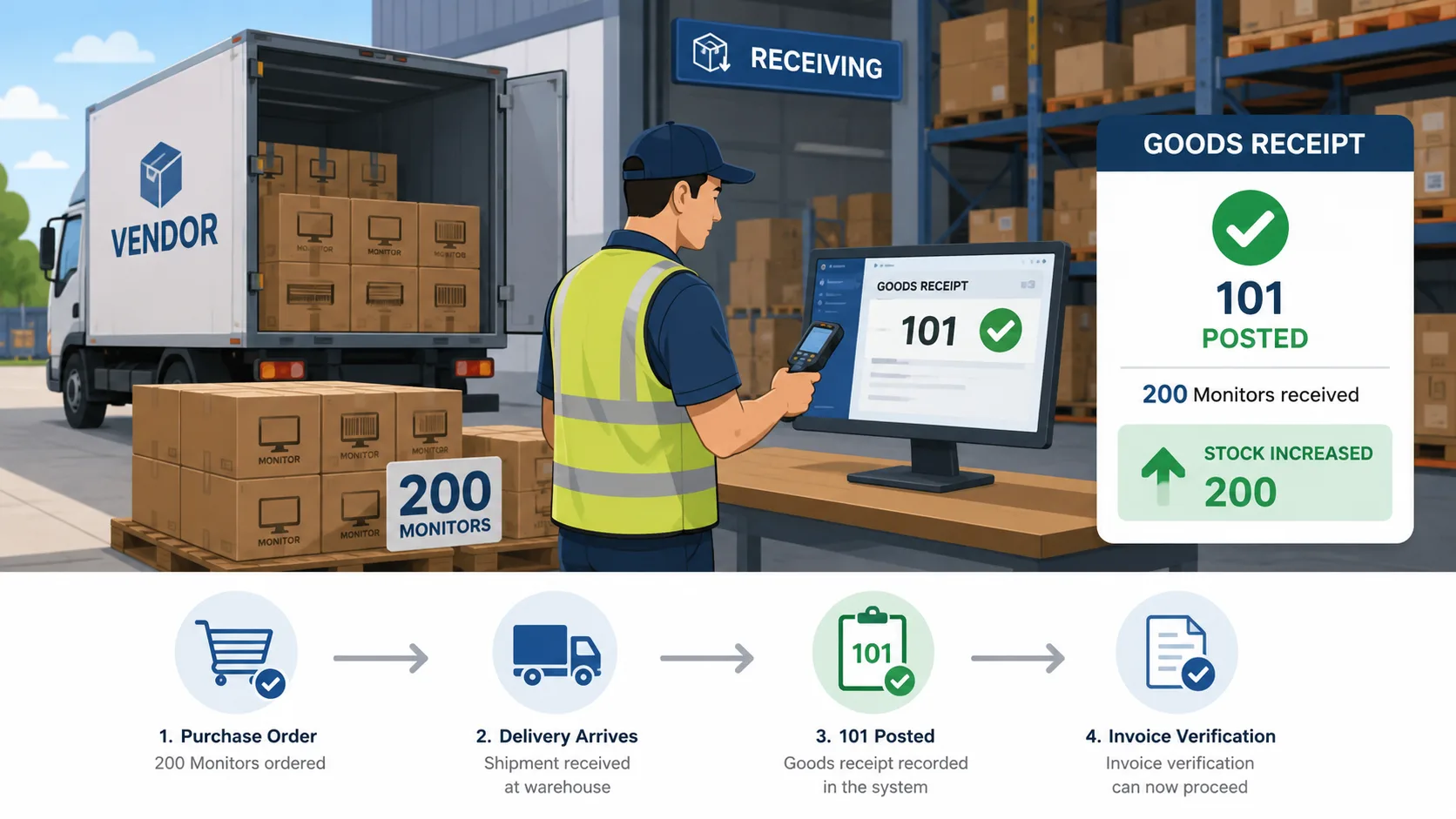
Example: Your company orders 200 monitors from a vendor. When the delivery arrives, the warehouse team posts a 101 to confirm the receipt. Stock goes up, invoice verification can now proceed.
Goods Issue Movement Types
| Movement Type | Description |
|---|---|
| 201 | Goods Issue to Cost Centre |
| 261 | Goods Issue to Production Order |
| 281 | Goods Issue to Project |
| 551 | Scrapping / Withdrawal for Sampling |
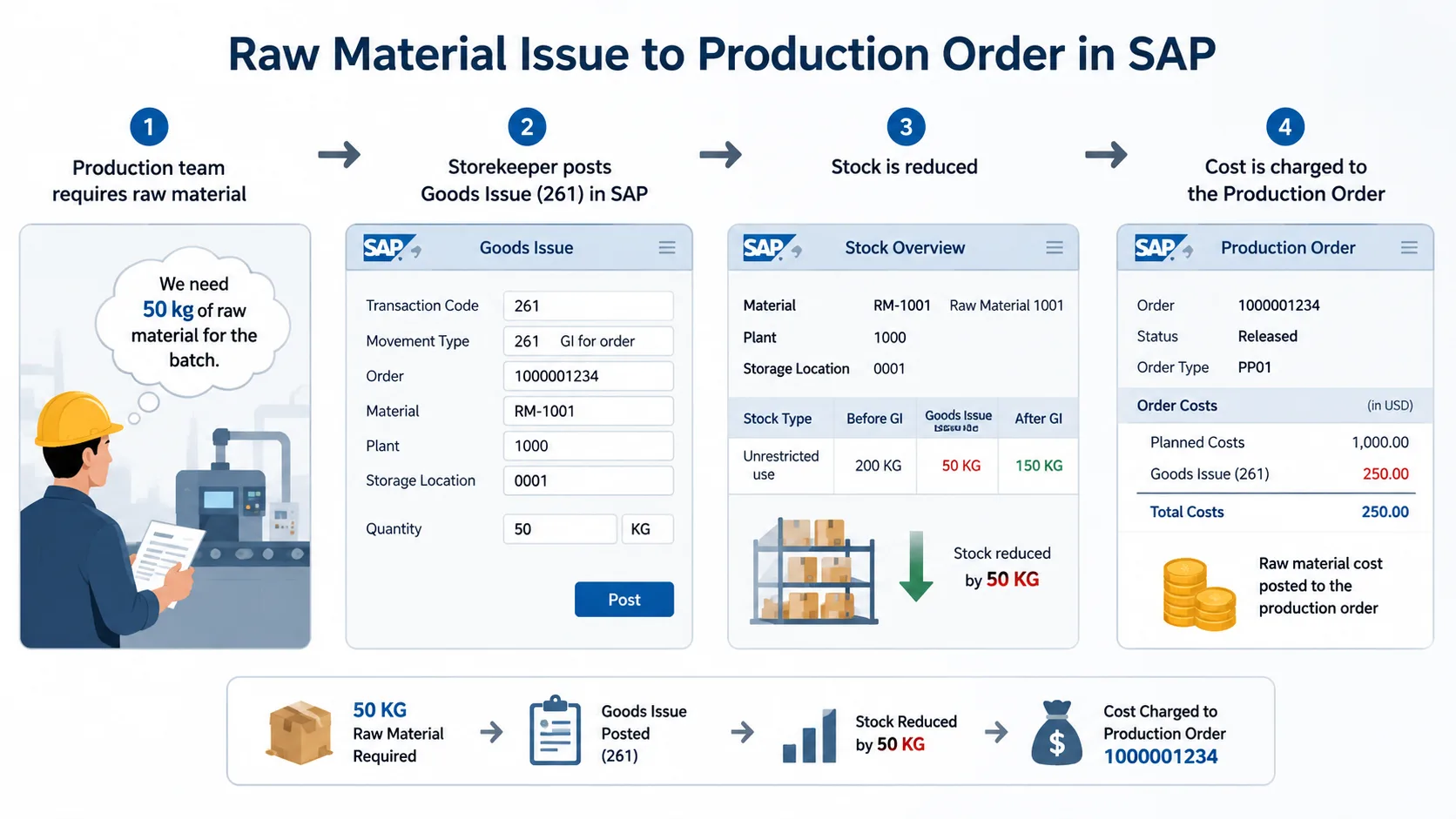
Example: The production team needs 50 kg of raw material to manufacture a batch. The storekeeper posts a 261 in SAP. Stock is reduced, and the cost is charged to the production order.
Stock Transfer Movement Types
| Movement Type | Description |
|---|---|
| 311 | Transfer Posting within Plant (storage location to storage location) |
| 301 | Stock Transfer between Plants (one-step) |
| 303/305 | Stock Transfer between Plants (two-step) |
| 411 | Transfer from Special Stock to Own Stock |
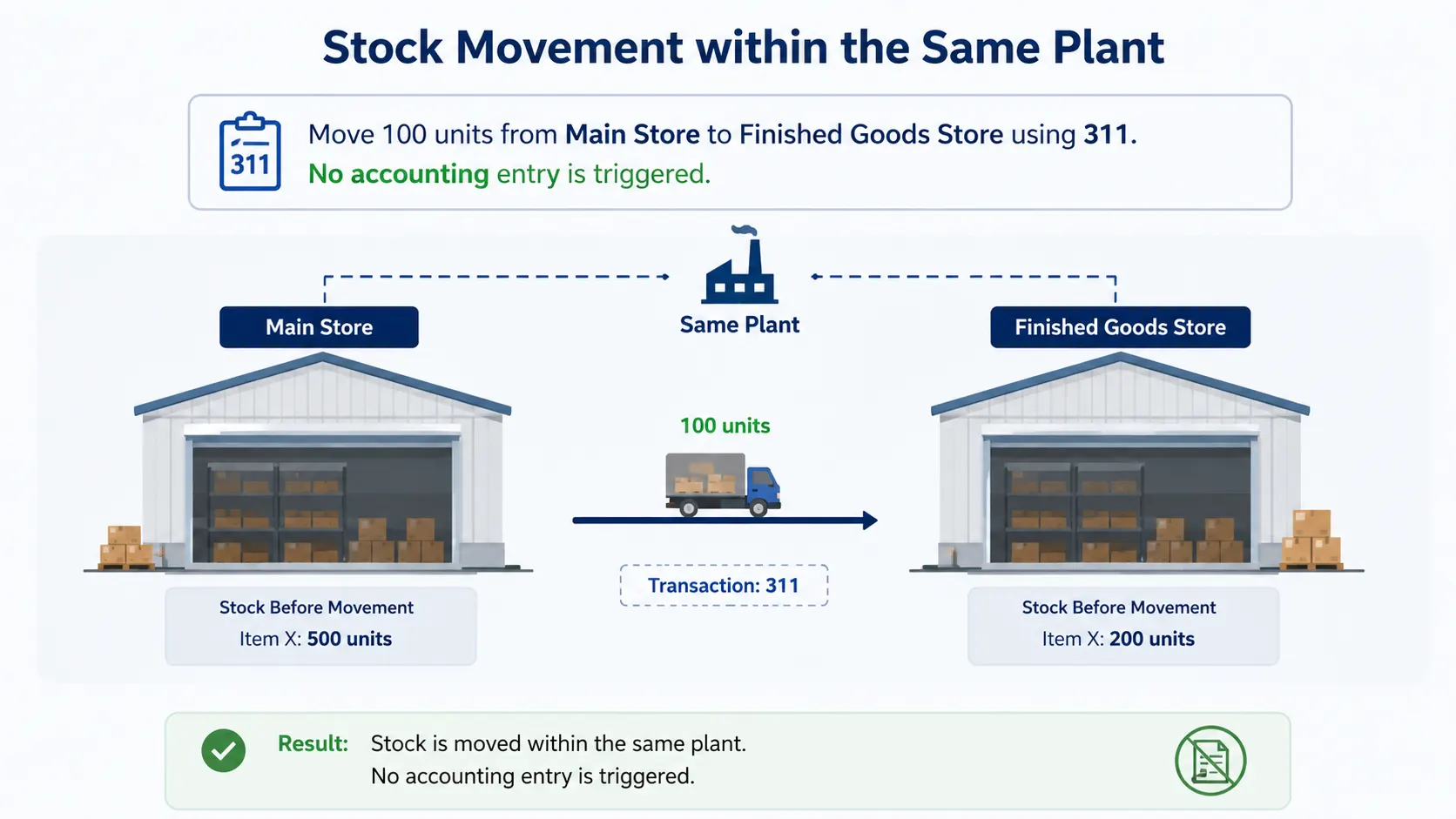
Example: Your company has two warehouses in the same plant, the Main Store and Finished Goods Store. You move 100 units from one to the other using 311. No accounting entry is triggered, just a stock movement within the plant.
Return and Reversal Movement Types
| Movement Type | Description |
|---|---|
| 102 | Reversal of Goods Receipt (against PO) |
| 122 | Return Delivery to Vendor |
| 262 | Reversal of Goods Issue to Production Order |
| 161 | Returns from Customer |
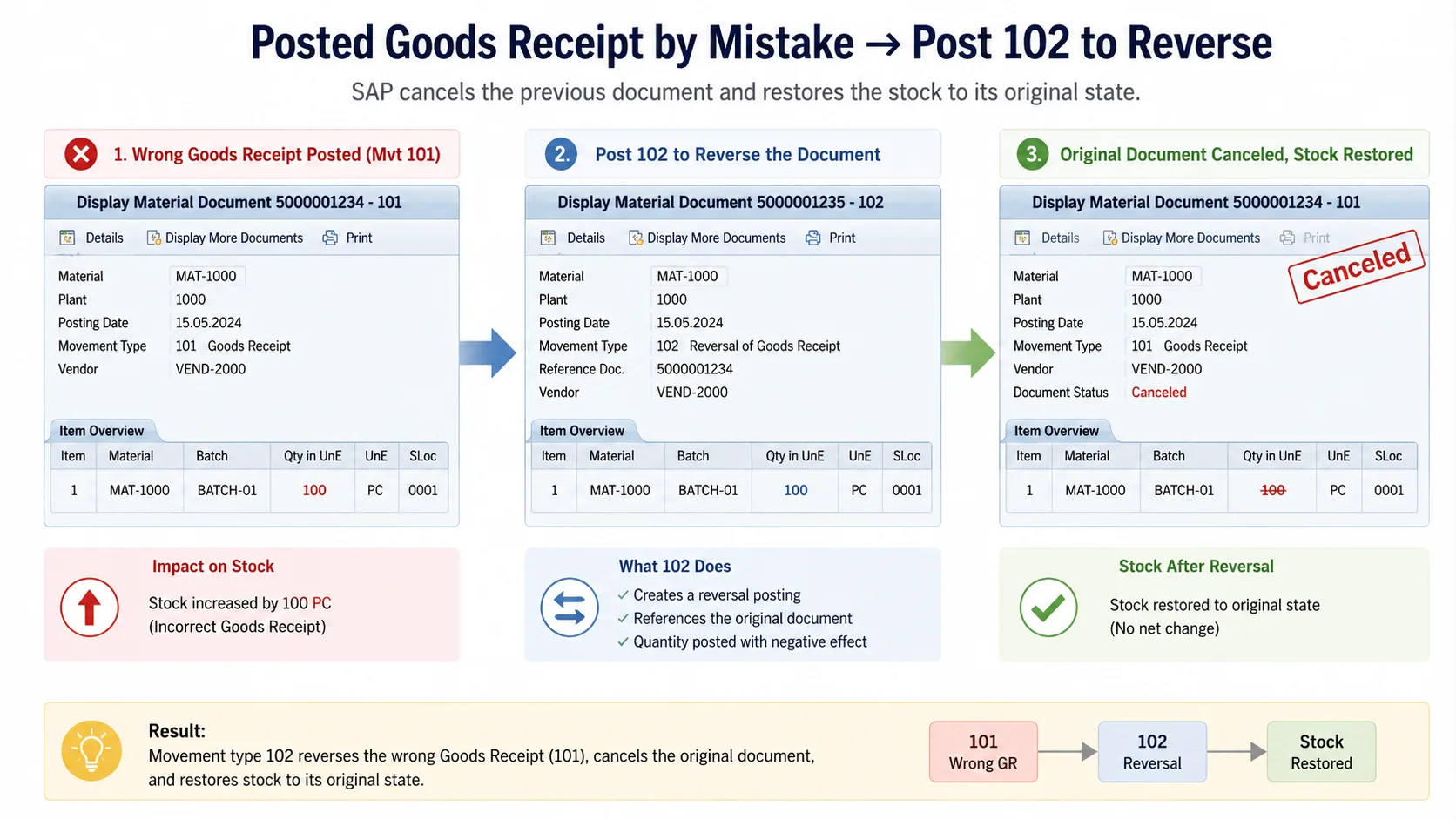
Example: You posted a goods receipt by mistake, with the wrong quantity. Post a 102 to reverse it. SAP cancels the previous document and restores the stock to its original state.
Special Stock Movement Types
| Movement Type | Description |
|---|---|
| 101 K | Goods Receipt for Consignment Stock |
| 411 K | Transfer Consignment Stock to Own Stock |
| 541 | Transfer to Subcontracting Stock |
| 543 | Goods Issue for Subcontracting |
What Happens When You Post a Movement Type?
This is where it gets interesting and where most tutorials stop short.
Every time you post a movement type in SAP MM, three things happen simultaneously:
- Material Document is created: This is your proof of transaction. It records what moved, when, where, and how much.
- Accounting Document is generated: The system posts automatic journal entries based on the valuation class and account determination configured in your SAP system.
- Stock quantities are updated in real time: Whether it’s unrestricted stock, quality inspection stock, or blocked stock, SAP updates the relevant stock type instantly.
This is why movement types are not just a logistics concept; they sit right at the intersection of inventory management, procurement, and finance.

Movement Type Configuration: What Does It Control?
If you ever go into SAP configuration (SPRO), a single movement type controls:
- Quantity update: Does it increase or decrease stock?
- Value update: Does it trigger an accounting entry?
- Stock type: Unrestricted, quality inspection, blocked, or special stock?
- Reversal movement type: What’s the undo code?
- Print/document settings: What gets printed or logged?
- Reason codes: Optional codes for audit trails
This is also important for SAP consultants who configure the system for clients. Understanding the logic behind movement types helps you avoid costly setup errors.
How ICA Edu Skills Helps You Actually Learn SAP MM
Here’s the truth about most SAP courses: they teach you what the movement types are, but not how to work with them confidently in a live system.
At ICA Edu Skills, the SAP MM training is structured differently. You don’t just sit through theory, you work on practice scenarios in a live SAP environment, posting real transactions, handling real errors, and building the confidence that employers actually look for.
The curriculum covers the full SAP MM module, procurement, inventory management, vendor master, invoice verification, and movement types in depth, along with preparation for real-world job roles like:
- SAP MM Functional Consultant
- Store/Warehouse Executive with SAP
- Supply Chain Analyst
- ERP Implementation Support
With NSDC-affiliated certification and dedicated placement support, ICA Edu Skills has helped thousands of students and professionals land SAP roles across India in manufacturing, pharma, FMCG, retail, and more.
If movement types still feel abstract after reading this, imagine practising them live, posting a 101, reversing it with a 102, transferring stock with a 311, and seeing every document and accounting entry appear in real time.
Common Mistakes Beginners Make with Movement Types
- Using 501 instead of 101: 501 is for receipt without a PO. Using it incorrectly breaks the procurement cycle and creates audit issues.
- Forgetting to reverse before re-posting: If you entered the wrong quantity, always reverse (102/122) before re-posting. Don’t just post a new document to “balance it out.”
- Confusing 311 and 301: 311 is within the same plant. 301 is between plants. The accounting impact is completely different.
- Not checking stock type: A movement type may post to quality stock instead of unrestricted stock, causing confusion when the material “disappears” from usable inventory.
Movement Types in SAP MM: Quick-Reference Sheet
| Category | Key Movement Types |
|---|---|
| Goods Receipt (with PO) | 101, 103, 105 |
| Goods Receipt (without PO) | 501, 521 |
| Goods Issue | 201, 261, 551 |
| Stock Transfer | 301, 303, 311 |
| Reversals / Returns | 102, 122, 262 |
| Subcontracting | 541, 543 |
| Consignment | 101K, 411K |
| Physical Inventory | 701, 702 |
Conclusion
SAP MM might look intimidating from the outside. But once you understand that movement types are simply instructions that tell the system what’s happening to your stock, the entire module starts to make more sense.
Start with the big five: 101, 102, 201, 261, 311. Get comfortable posting them. Understand what documents they generate. Then build outward.
Every SAP MM professional you admire started exactly where you are confused, curious, and willing to learn.
Few SAP related topics for your knowledge
- Accounts Receivable Process In SAP:A Step-by-Step Process
- SAP FICO Enterprise Structure: A Comprehensive Guide
- Accounts Payable Process in SAP: Step by Step Guide
- Vendor Reconciliation in SAP: Definition, Steps, Scenario, Advantages
- SAP Order To Cash Process: Optimizing Financial Flows
- 25+ SAP MM Interview Questions & Answers: Cheat Sheet You Need Today
Frequently Asked Questions
1. What are the movement types in SAP MM?
Movement types are three-digit codes in SAP MM that categorize every inventory transaction: goods receipt, goods issue, stock transfer, or return. They control stock updates, accounting entries, and document creation automatically.
2. What is movement type 101 in SAP MM?
Movement type 101 is used for posting a Goods Receipt against a Purchase Order. It increases unrestricted stock, creates a material document, and triggers an automatic accounting entry debiting inventory and crediting the GR/IR clearing account.
3. What is the difference between movement type 101 and 501 in SAP?
Movement type 101 is a goods receipt against an existing Purchase Order, while 501 is a goods receipt without any reference to a PO. The key difference lies in accounting treatment and procurement traceability. 101 is tied to the full procurement cycle; 501 is not.
4. How many movement types are there in SAP MM?
SAP MM has over 100 standard movement types, grouped by category: goods receipts, goods issues, stock transfers, miscellaneous receipts, delivery movements, and physical inventory. Custom movement types can also be configured.
5. Is knowledge of movement types important for SAP MM interviews?
Absolutely. Movement types are one of the most frequently tested topics in SAP MM interviews. Interviewers commonly ask about 101 vs 501, reversal postings, stock transfer differences (311 vs 301), and how movement types link to accounting. A strong grasp of these sets you apart.

- Skill Development Institute in India - September 26, 2026
- Master Data in SAP PP: The Skill Recruiters Test First - September 18, 2026
- Nobody’s Talking About These Basic Computer Skills For Beginners - September 11, 2026