














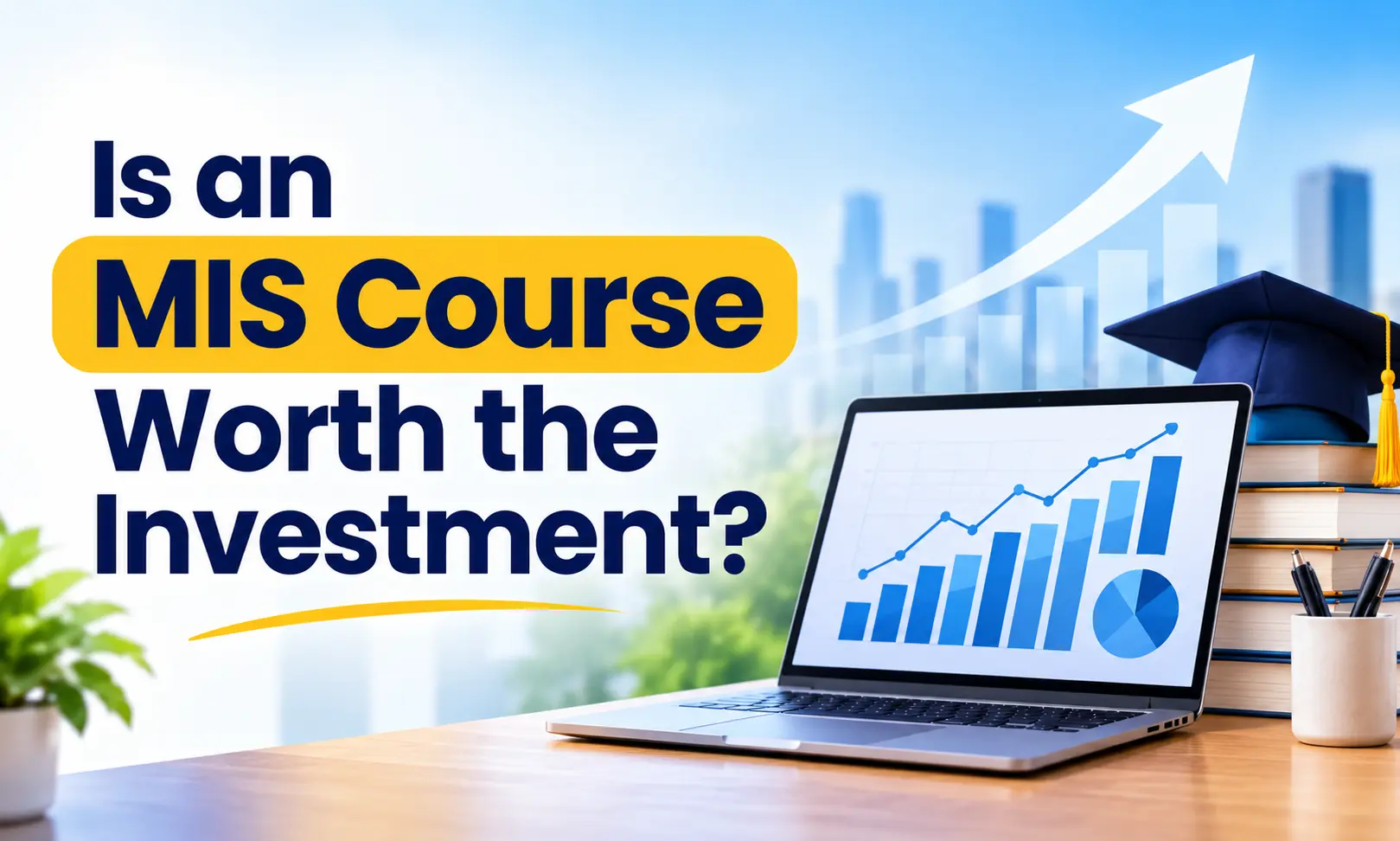
Is an MIS Course Worth the Investment?







You have a degree. You have a resume. Yet every job listing asks for “MIS reporting” and “Advanced Excel”, and you aren’t sure where to start. If that sounds familiar, keep reading.
What Is an MIS Course?
MIS (Management Information System) training teaches you to turn raw business data into reports that managers use to make decisions. You learn Excel formulas, pivot tables, dashboards, data cleaning, and basic Power BI. It isn’t coding-heavy, so commerce, arts and science graduates can pick it up.
How to Measure the ROI
ROI isn’t just about the fee. Look at three things:
- Money: What you pay vs. the salary jump an MIS or reporting role can bring.
- Time: A few weeks of learning vs. months of job hunting with a generic resume.
- Shelf life: Reporting and Excel skills stay useful in almost every industry.
Master MIS skills and boost your career potentialUnlock high-demand MIS job opportunities—Join our industry ready course today! |
|
| Classroom CourseOnline Course | |
| More Learning Options for you: | |
| Certificate in Data Science | Advanced Excel Course | |
A Quick Scenario
Two B.Com graduates apply for the same MIS Executive role. One writes “MS Office” on the resume. The other attaches a sales dashboard built with pivot tables and lookup formulas.
Guess whose phone rings first? Same degree, different proof of skill.
MIS Course vs. Other Options
- Another degree: Takes 1–2 years, costs a lot, and teaches broad theory.
- Free videos: No fee, but no structure, no feedback, and no recognised certificate.
- Structured MIS course: Takes weeks, costs moderately, and builds role-ready skills.
When It May Not Be Worth It
Be honest with yourself. If you only want a certificate and won’t practise, the ROI drops. The course gives you the tools, but you have to use them.
Where ICA Edu Skills Fits In
If you want a structured route, ICA Edu Skills offers an NSDC-certified MIS course built around real reporting work. Alongside the technical modules, you get monthly mock interviews, group discussions, and resume preparation. That helps you explain your skills in an interview, not just learn them.
Few related topics for your knowledge
- 40+ Important Interview Trial Balance Questions & Answers
- Top 30 MIS Analyst Interview Questions & Answers
- Don’t Miss These 40 G Suite Interview Questions to Land Your Dream Job
- 80 Most Common Power BI Interview Questions and Answers
- Career in Management Information System: Insights, Scope, Opportunities
Final Thoughts
An MIS course pays off when three things line up: you choose a structured programme, you practise regularly, and you aim for roles that need data reporting. The fee is a one-time cost, while the skill keeps earning for years. Decide where you want to be in six months, then pick the path that gets you there.
Frequently Asked Questions
1. Is an MIS course good for freshers?
Yes. Most MIS roles are entry-level, and employers look for Excel and reporting skills rather than years of experience.
2. Can non-IT graduates learn MIS?
Yes. Commerce, arts, and science graduates can learn it, since the focus is Excel and reporting, not programming.
3. How long does it take to see returns?
It depends on your practice and job search. Learners who build a few dashboards and prepare well for interviews often start applying within weeks of finishing.
- Is an MIS Course Worth the Investment? - November 5, 2026
- Stock Market Crash 2026: Is the AI Bubble Bursting? - November 2, 2026
- Power BI Training Classes: Your Shortcut Into Data Jobs - October 31, 2026