
















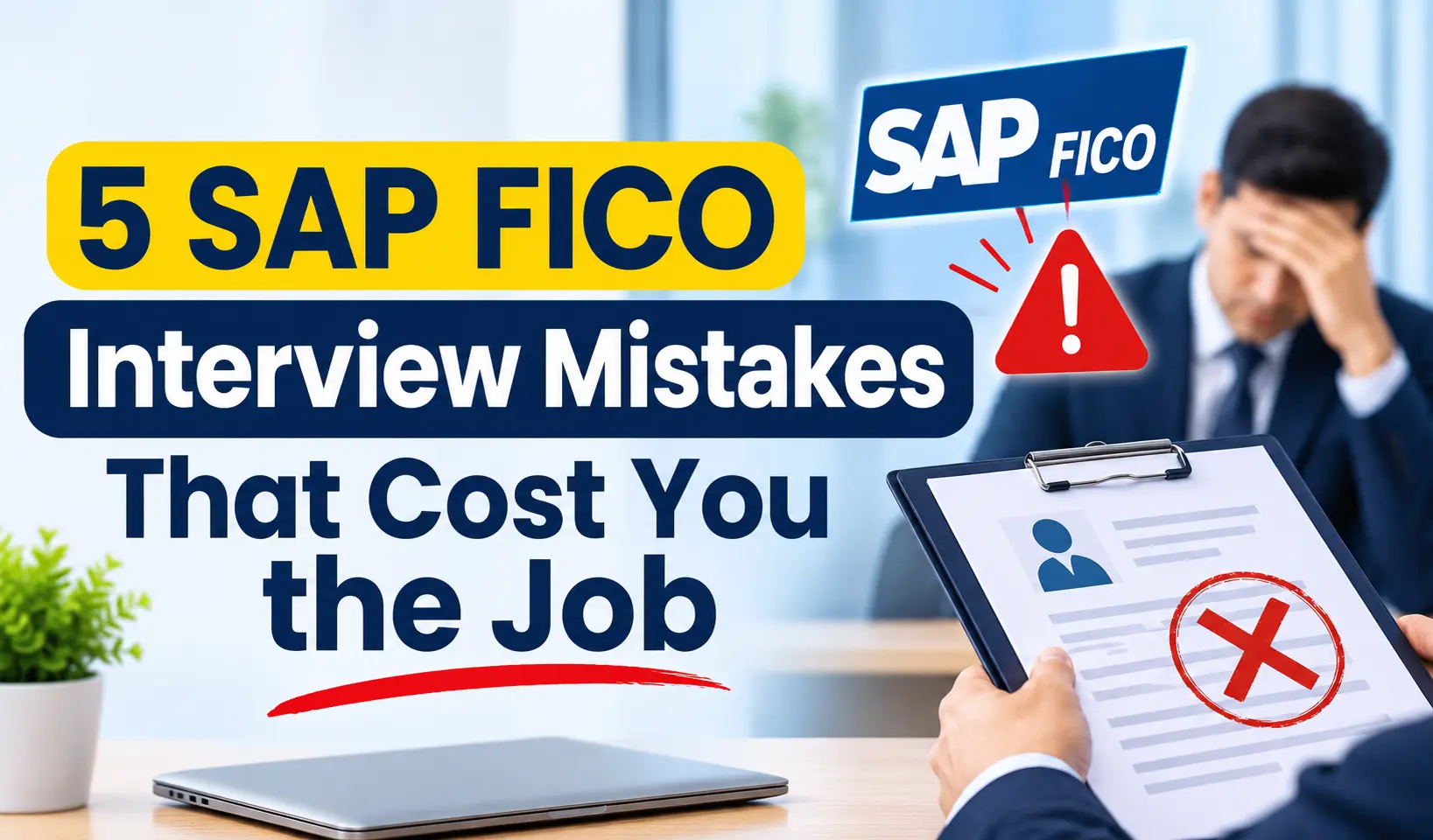
5 SAP FICO Interview Mistakes That Cost You the Job







Quick answer: The most common SAP FICO interview mistakes are explaining processes only through T-codes, overcomplicating simple concepts, ignoring module integration, memorising configuration steps without the reason behind them, and neglecting soft skills. Fix them by thinking in business flows, answering simply, linking FI/CO with MM and SD, explaining the “why”, and practising scenario answers.
You spent weeks learning SAP FICO. You know FB60, F-02, and your way around the menu paths.
Then the interviewer asks, “Walk me through what happens when a vendor invoice is posted.” You list three T-codes and stop. The room goes quiet.
Candidates rarely lose SAP FICO interviews because they don’t know the software. They lose because they can’t connect the software to the business. Here are the five mistakes that cause it, and how to fix each one.
What Is SAP FICO, and What Are Interviewers Really Testing?
SAP FICO combines two modules of SAP’s ERP system:
- FI (Financial Accounting): records the company’s official books, including general ledger, vendors, customers, and assets.
- CO (Controlling): tracks internal costs and profits through cost centres, internal orders, and profitability analysis.
Interviewers use your answers to check one thing: can you handle real finance work in SAP, or have you only learned where to click?
Mistake 1: Why Does Explaining Everything in T-Codes Hurt Your Answer?
The mistake: You describe accounting work only as transaction codes, such as “I post the invoice using FB60.” A T-code tells the interviewer where you clicked. It doesn’t show that you understand why.
The fix: Answer in end-to-end business flows.
- Procure-to-Pay (P2P): purchase requisition → purchase order → goods receipt → invoice verification → vendor payment
- Order-to-Cash (O2C): sales order → delivery → billing → customer payment
| Interviewer asks | Weak answer | Strong answer |
| “What happens when a vendor invoice arrives?” | “I go to FB60 and post it.” | “With a purchase order, goods receipt comes first and the system books stock against a GR/IR clearing account. Invoice verification then clears GR/IR and creates the vendor liability. The payment run finally clears that liability against the bank. I use FB60 for invoices with no PO, like a utility bill.” |
Mention the T-code at the end, as a detail, not as the answer.
Rule the Market with Professional SAP Training |
|||
| SAP Certification Courses | |||
| Explore All SAP Courses | |||
| SAP FICO Course | SAP MM Course | SAP PP Course | SAP SD Course | |||
Mistake 2: Are You Making Simple SAP FICO Concepts Sound Complicated?
The mistake: Many freshers think a long, jargon-heavy answer sounds more expert. It usually sounds like memorised notes.
The fix: Use one plain sentence for the definition and one example.
- Tolerance group: a limit on how big a difference an employee can accept while posting or clearing before a manager has to step in.
- Document splitting: lets SAP break one posting into parts, such as by profit centre or segment, so you get a balanced report for each part of the business and not only the whole company.
If you can’t explain a concept to a friend from a non-commerce background, the interviewer will doubt you understand it yourself.
Mistake 3: Why Does Ignoring Module Integration Cost Candidates Offers?
The mistake: You treat FI and CO as separate islands. In a real company, they work with other modules all day.
The fix: Be ready to explain these links:
- MM (Materials Management): a goods receipt automatically creates postings to stock and GR/IR accounts.
- SD (Sales & Distribution): billing creates the customer invoice and posts revenue in FI.
- PP (Production Planning): production orders collect costs that CO later settles.
- CO link: an expense posting often needs a cost centre, so FI and CO meet in one entry.
Practice scenario: “A storekeeper issues material to a cost centre. What is the accounting impact?”
Good answer: debit the consumption expense to the assigned cost centre, and credit inventory. That one answer shows MM, FI, and CO working together.
Mistake 4: Does Memorising Configuration Steps Work in SAP FICO Interviews?
The mistake: You can recite a menu path but freeze when asked why a setting exists.
The fix: For every setting you’ve learned, be able to state the business need behind it.
| Setting | The “why” to say out loud |
| Field status group | Controls which fields are mandatory, optional, or hidden while posting. For example, forcing a cost centre on expense accounts so no cost goes untracked. |
| Fiscal year variant | Defines the financial year and posting periods, such as April to March for most Indian companies. |
| Depreciation areas | Let one asset carry different depreciation values, such as one for company books and another for income-tax purposes. |
Also know that master data errors flow into live postings. For example, a wrong reconciliation account on a vendor master puts balances in the wrong place on the balance sheet.
Mistake 5: Can Soft Skills Really Decide an SAP FICO Interview?
The mistake: You prepare for a technical exam, but the interview is partly a test of how you’d handle clients.
The fix: Practise scenario answers. A common one: “A finance manager wants an invoice posted into a closed period. What do you do?”
A strong answer:
- Listen and acknowledge the urgency.
- Explain in plain words why the period is closed.
- Offer the proper route, such as approval to reopen it, or posting in the current period with the right references.
Interviewers watch for three things here:
- Calm and clear communication
- Willingness to ask clarifying questions
- Ability to explain accounting rules to people who don’t know SAP
Quick Pre-Interview Checklist
- Say P2P and O2C aloud, with the accounting entry at each step.
- Prepare one-line definitions for 10 core concepts.
- Link every FI topic to at least one other module.
- Know the “why” behind each setting you’ve learned.
- Prepare two stories about handling a difficult user or deadline.
- Do at least two mock interviews out loud.
Is SAP FICO Still Worth Preparing For in 2026?
Yes, and the numbers support it.
- Flexiple’s India data (updated August 2026) shows median SAP FICO consultant pay rising about 3.3 times over a career, from ₹3.6 lakh at 0–2 years to ₹11.7 lakh at 12+ years. These are self-disclosed figures, so treat them as a guide, not a guarantee.
- SAP’s own plan ends mainstream maintenance for Business Suite 7 core applications (including ECC) on 31 December 2027, with optional extended maintenance through 2030.
- The DSAG Investment Report, as cited by consultancy IBsolution, says nearly half of existing SAP customers plan to finish their migration by the end of 2030.
Migration projects need people who understand finance processes inside SAP. That is exactly what interviewers are screening for.
Sources: Flexiple (flexiple.com/salary/sap-fico-consultant), SAPinsider (sapinsider.org), IBsolution citing the DSAG Investment Report (ibsolution.com).
How Can You Practise Before the Real Interview?
Knowing the mistakes helps, but speaking the answers aloud is what builds confidence.
ICA Edu Skills, an NSDC-certified institute, offers SAP FICO training as a standalone course and as part of its Certified Industrial Accountant (CIA) programme. Its courses also include mock interviews, group discussions, and resume preparation, so you can rehearse the soft-skill side as well as the technical side.
Few SAP related topics for your knowledge
- Accounts Receivable Process In SAP:A Step-by-Step Process
- SAP FICO Enterprise Structure: A Comprehensive Guide
- Accounts Payable Process in SAP: Step by Step Guide
- Vendor Reconciliation in SAP: Definition, Steps, Scenario, Advantages
- SAP Order To Cash Process: Optimizing Financial Flows
- 25+ SAP MM Interview Questions & Answers: Cheat Sheet You Need Today
Conclusion
SAP FICO interviews reward candidates who think like finance professionals who happen to use SAP.
Before your next interview, pick one process, such as P2P. Explain it aloud in plain business language, then add the T-codes last. If you’d like structured guidance, you can explore the SAP FICO course at ICA Edu Skills.
Frequently Asked Questions
1. What are the most common SAP FICO interview mistakes?
The big five: explaining everything through T-codes, over-complicating simple concepts, treating FI and CO as separate from MM and SD, memorising configuration without knowing why, and ignoring soft skills. Interviewers mostly test business understanding, not button-clicking.
2. How do I prepare for an SAP FICO interview as a fresher?
Learn the core flows first: Procure-to-Pay and Order-to-Cash. Practise the journal entries behind each step, then revise G/L, accounts payable, accounts receivable, asset accounting, and cost centres. Do a few mock interviews out loud, because explaining clearly is a skill that needs practice.
3. What questions are asked in an SAP FICO interview?
Expect questions on the chart of accounts, document types, posting keys, vendor and customer master data, payment runs, asset depreciation, cost centres, and profit centres. Scenario questions are common too, such as “What happens in FI when goods are received?”
4. Is SAP FICO hard to learn for commerce students?
It’s manageable if you already know accounting basics like debits, credits, and the trial balance. The software feels complex at first, but most of it follows accounting logic. Commerce and finance graduates usually pick it up faster than those starting from zero.
5. What is the salary of an SAP FICO consultant in India?
Flexiple’s August 2026 India data shows a median of about ₹3.6 lakh a year at 0–2 years’ experience, rising to about ₹11.7 lakh at 12+ years. Actual pay varies by company, city, certifications, and the projects you work on.

- 5 SAP FICO Interview Mistakes That Cost You the Job - November 13, 2026
- Are NSDC Certificates Worth It for Getting a Job? - November 10, 2026
- SAP PP vs SAP MM: Which Should I Learn? - November 7, 2026