.jpg)

















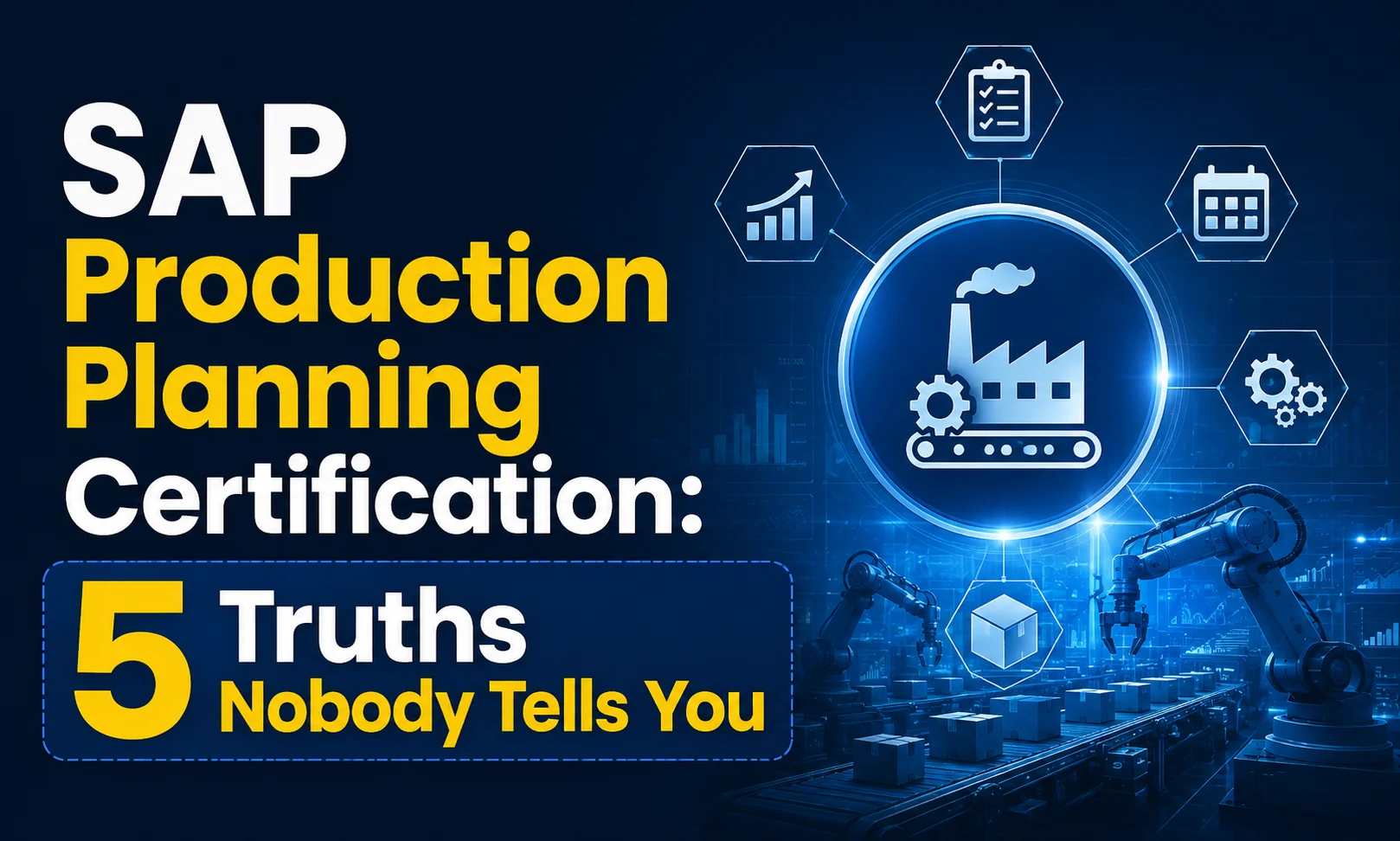
SAP Production Planning Certification: 5 Truths Nobody Tells You







Summary
An SAP Production Planning (SAP PP) certification proves you can configure and run SAP’s manufacturing module, covering material planning, capacity management, and shop floor execution. The current associate-level exam, C_TS422, tests real configuration skills, not theory, and opens doors to production planner, SAP consultant, and analyst roles across India’s manufacturing sector.
Scroll through LinkedIn for five minutes, and you’ll spot it: another fresher announcing a new job, another career switcher posting a “new chapter” update. Meanwhile, you’re refreshing job portals, wondering what actually moves the needle.
Here’s the uncomfortable truth: a degree alone doesn’t get you hired into India’s manufacturing and supply chain boom anymore. The right skill does. And if you’ve been typing “SAP PP certification” into Google at 1 AM, you’re closer to that answer than you think.
Let’s break down what this certification actually is, whether it’s worth your time and money, and what most course brochures leave out.
Table of Contents
What Is SAP Production Planning (SAP PP)?
SAP Production Planning (SAP PP) is the module inside SAP’s ERP and S/4HANA systems that runs a factory’s entire production cycle from forecasting demand to scheduling the shop floor. Think of it as the digital brain that decides what to make, how much to make, and when.
In practice, SAP PP handles:
- Master data: bills of material (BOM), work centres, and routings
- Demand and sales & operations planning (S&OP)
- Material requirements planning (MRP), deciding what to procure or produce, and when
- Capacity evaluation and levelling across machines and shifts
- Shop floor execution through production and process orders
If you’ve ever wondered how a car factory knows exactly how many bolts, engines, and dashboards to order for next month’s production run, this module is the answer.
What Is the SAP Production Planning Certification, Exactly?
The certification is officially called the SAP Certified Associate – SAP S/4HANA Cloud Private Edition, Production Planning and Manufacturing exam, with exam code C_TS422. It’s SAP’s entry-level (Associate) credential for this module; no prior SAP project experience is formally required to sit for it.
Quick facts:
- Level: Associate SAP’s foundational tier, sitting below Specialist and Professional certifications
- What it tests: Configuration and transaction execution inside the system, not just multiple-choice theory. SAP’s Associate-level exams run around 80 questions within a roughly three-hour window, though the exact format can shift between exam versions; always check the current exam guide before booking
- Cost: In the range of $200 (roughly ₹17,000–18,000), though SAP revises exam pricing periodically; confirm on the official SAP Learning site before you pay
- Prerequisites: None formally required, but candidates with some exposure to manufacturing or ERP concepts usually find it easier to clear
Rule the Market with Professional SAP Training |
|||
| SAP Certification Courses | |||
| Explore All SAP Courses | |||
| SAP FICO Course | SAP MM Course | SAP PP Course | SAP SD Course | |||
5 Truths About the SAP PP Certification Nobody Tells You
Before you spend money on a course, here’s what most brochures leave out:
- It’s not a coding skill; it’s process logic.
- The certificate alone won’t get you hired; being able to explain real scenarios will.
- Freshers and career switchers are equally welcome; this isn’t a CS-only path.
- Your salary jumps meaningfully once you pair PP with a second module.
- The demand behind this skill is structural, not a passing trend.
Let’s look at each one.
Truth #1: SAP PP Isn’t a Coding Skill
If the word “SAP” makes you picture lines of code, relax. SAP PP is configuration-based; you’re setting up business rules, master data, and planning parameters inside the system, not writing programs.
Who can realistically learn it:
- Commerce and BBA graduates who understand basic business processes
- Mechanical, production, and industrial engineering graduates
- Even arts graduates comfortable with logical, step-by-step thinking
The actual learning curve isn’t syntax; it’s understanding manufacturing logic: what a BOM is, how an MRP run decides what to produce, why capacity levelling matters. Once that clicks, the software part is mostly a matter of practice.
Truth #2: Certification Alone Won’t Get You Hired
This is the part course brochures skip. A certificate proves you know the concepts. It doesn’t prove you can handle a live scenario, and interviewers know the difference.
FactorsCertification aloneCertification + hands-on practiceResume shortlistingPasses keyword filtersSame, plus project-ready languageInterview performanceCan define termsCan walk through an actual MRP run or BOM changeRamp-up on Day 1 of a jobSteep learning curveFaster, more confident start
| Factors | Certification alone | Certification + hands-on practice |
|---|---|---|
| Resume shortlisting | Passes keyword filters | Same, plus project-ready language |
| Interview performance | Can define terms | Can walk through an actual MRP run or BOM change |
| Ramp-up on Day 1 of a job | Steep learning curve | Faster, more confident start |
If your course only prepares you for the exam and not for a real client scenario, you’re solving half the problem.
Truth #3: Freshers and Career Switchers Are Equally Welcome
Take Rohan (name changed), a diploma holder who spent four years supervising a shop floor at an auto-ancillary unit. He knew production inside out but had never touched SAP. A few months into learning SAP PP, he realised he already understood the logic of checking stock and planning the next batch; he just hadn’t seen it inside a system before.
His first interview question wasn’t “what is SAP?” It was “walk me through how you’d handle a shortage alert in the system.” He got the offer not because he was new to production, but because he could now speak the software’s language on top of it.
If you’re a fresher, employers often hire you specifically because you come without old habits to unlearn. If you’re switching from a non-IT background, your domain knowledge is usually your biggest advantage; SAP PP just gives it a system vocabulary.

Truth #4: Your Salary Jumps When You Pair PP With a Second Module
Real numbers matter more than motivational quotes, so here they are. Entry-to-mid-level SAP PP consultants in India report average annual pay between roughly ₹5.5 lakh and ₹8.3 lakh, based on recent Glassdoor and PayScale data. Consultants who combine PP with a second module like Quality Management (QM) report noticeably higher averages, with top earners crossing ₹15–25 lakh.
The takeaway: SAP PP is a strong entry point, but pairing it with an adjacent module over time is often what pushes your pay bracket up.
Truth #5: This Demand Is Structural, Not a Trend
It’s fair to be sceptical of any “hot skill” claim. So look at the macro picture instead of the hype:
- SAP is the world’s largest ERP vendor by market share, and manufacturing is the single biggest industry vertical for ERP software adoption.
- India’s manufacturing sector currently contributes around 17% of GDP, and government policy through the National Mission on Manufacturing and the PLI scheme is targeting a rise to 25% by 2035.
- More factories and expanding supply chains mean more companies implementing or upgrading SAP systems and more seats needed for people who understand production planning inside them.
This isn’t a skill riding a temporary wave. It’s tied to a decade-long industrial policy push.
How Do You Pick the Right SAP Production Planning Course?
So how do you actually choose among the dozens of SAP PP courses advertised online? Look past the brochure and ask three questions:
- Does the trainer explain manufacturing logic before diving into configuration steps, or does it jump straight to clicking through screens?
- Does the program build in interview-readiness mock scenarios, client-style questions beyond just exam prep?
- Does the syllabus actually cover what a consultant uses on the job: master data setup, MRP configuration, capacity planning, the full production order lifecycle, and integration points with SAP MM and SAP QM?
This is where ICA Edu Skills’ approach to SAP training is worth a look. Instead of stopping at a certificate, the program builds in monthly mock interviews, group discussions, and SOBO (Speak Out Bowl Out) sessions because a consultant who can configure an MRP run but freezes in a client call doesn’t get staffed on projects. The courses are also aligned with NSDC-certified frameworks, which matters when a recruiter is scanning a resume for credentials they actually recognise.
If your goal is to walk into an interview talking through a live shortage scenario instead of reciting definitions, that’s the gap worth closing before you enrol anywhere.
Few SAP related topics for your knowledge
- Accounts Receivable Process In SAP:A Step-by-Step Process
- SAP FICO Enterprise Structure: A Comprehensive Guide
- Accounts Payable Process in SAP: Step by Step Guide
- Vendor Reconciliation in SAP: Definition, Steps, Scenario, Advantages
- SAP Order To Cash Process: Optimizing Financial Flows
- 25+ SAP MM Interview Questions & Answers: Cheat Sheet You Need Today
The Bottom Line
The SAP production planning certification won’t hand you a job on its own; nothing does. But paired with real configuration practice and the ability to explain manufacturing logic out loud, it’s one of the more direct ways to convert a mechanical, commerce, or even non-technical background into a stable career in India’s expanding manufacturing economy.
If you’re done Googling at 1 AM and ready to actually build the skill, it’s worth exploring how a structured SAP PP course like the one at ICA Edu Skills is put together, and whether it fits where you’re trying to go.
Frequently Asked Questions
1. What’s the difference between SAP PP and SAP PP/DS?
SAP PP handles standard MRP-based production planning. SAP PP/DS (Detailed Scheduling) is an advanced add-on for complex, constraint-heavy scheduling, often used in discrete or process manufacturing. Most learners start with core SAP PP before specialising in PP/DS.
2. How long does an SAP PP course usually take?
Most structured SAP PP courses run 2–4 months, depending on whether they’re weekday, weekend, or self-paced. Add extra time for hands-on practice and mock scenarios if you want interview-ready confidence, not just certificate completion.
3. Is SAP PP certification enough to get a job, or do I need experience too?
Certification alone rarely guarantees a job. Recruiters look for candidates who can explain real scenarios: MRP runs, BOM changes, shortage handling, not just definitions. Pair certification with project-based practice for the best shot at interviews.
4. Can someone from a non-IT background learn SAP PP?
Yes. SAP PP is configuration-based, not programming-based. Commerce, engineering, and even arts graduates can learn it with logical thinking and an understanding of manufacturing processes; no coding background required.
5. What is the salary of an SAP PP consultant in India?
Entry-to-mid-level SAP PP consultants in India report average annual pay between ₹5.5 lakh and ₹8.3 lakh, based on Glassdoor and PayScale data. Experienced consultants handling PP plus QM or MM often earn ₹15–25 lakh.

- Skill Development Institute in India - September 26, 2026
- Master Data in SAP PP: The Skill Recruiters Test First - September 18, 2026
- Nobody’s Talking About These Basic Computer Skills For Beginners - September 11, 2026