















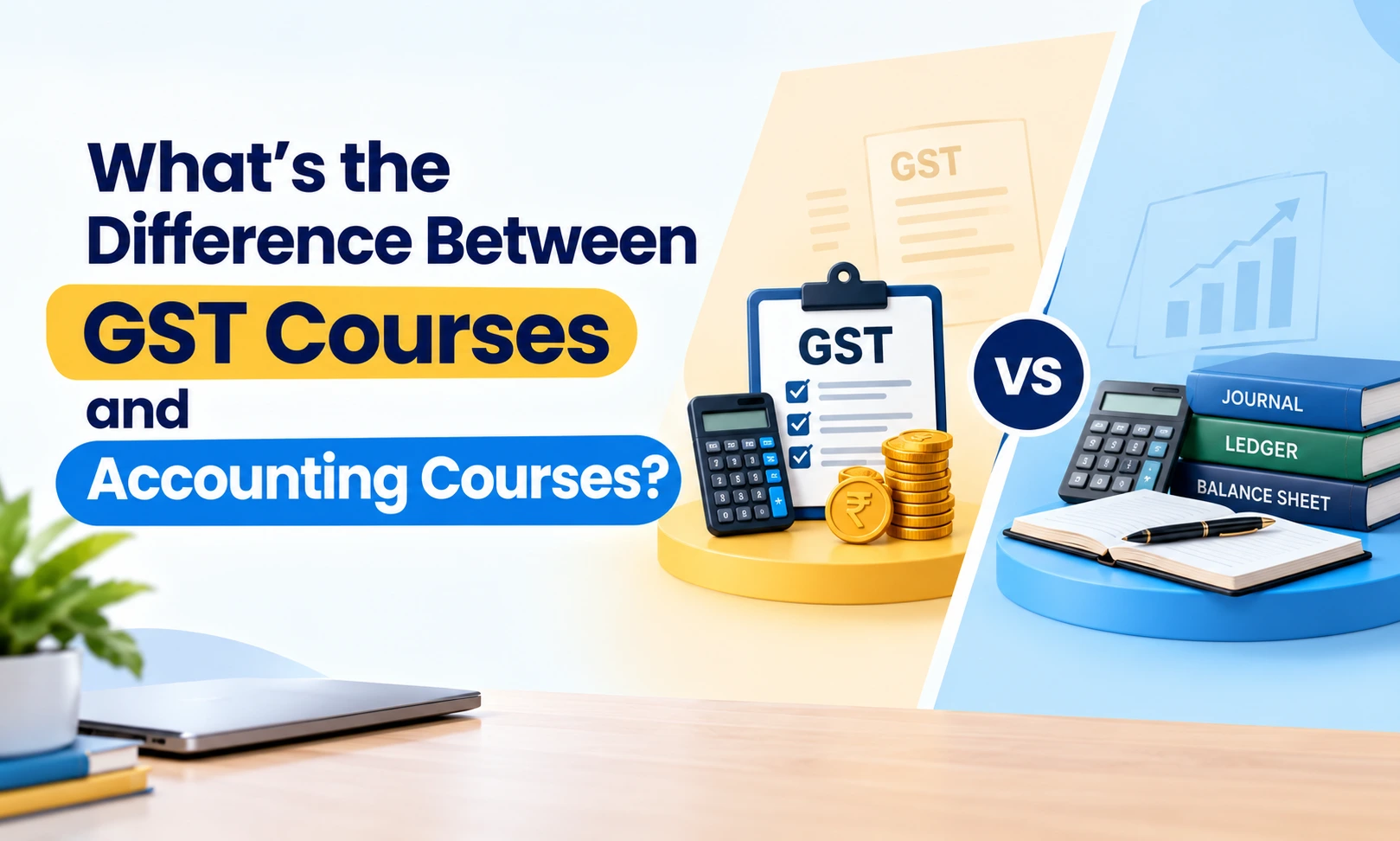
What’s the Difference Between GST Courses and Accounting Courses?







You’ve got two tabs open. One says “GST Course.” The other says “Accounting Course.” Both promise a finance career, and neither tells you which one is actually for you. Let’s fix that.
An accounting course teaches you how a business records and reports its money. A GST course teaches you how that business complies with indirect tax law. Accounting is the foundation. GST is a specialised skill that sits on top of it.
What an Accounting Course Covers
Think of this as learning the language of business money. You’ll work on:
- Journal entries, ledgers and trial balances
- Bank reconciliation and day-to-day bookkeeping
- Financial statements like the profit and loss account and balance sheet
- Accounting software such as TallyPrime
Roles it leads to: accounts assistant, accounts executive, bookkeeper, junior accountant.
What a GST Course Covers
GST touches almost every invoice a business raises. A GST course focuses on:
- GST registration and invoicing
- Filing returns like GSTR-1 and GSTR-3B
- Input tax credit and reconciliation
- E-way bills and e-invoicing
Roles it leads to: GST executive, tax assistant, compliance associate, GST practitioner support.

A Simple Scenario
Picture a small garment trader. The accountant records every sale, purchase, and expense. At month-end, the GST executive checks that tax collected and tax paid match, then files the return on time.Both are needed. But they are different jobs with different skills.
So, Which One Should You Pick?
Start with accounting if you:
- Are a fresher or a commerce student with no finance experience
- Want a broad base for any finance role
- Plan to grow into audit, payroll, or financial reporting later
Start with GST if you:
- Already know basic accounting or work in a billing or accounts role
- Want a specific, in-demand compliance skill
- Are a career switcher wanting a quicker route into tax work
Not sure? Pick the combination. Accounting plus GST makes you far more hireable than either alone, because most employers want one person who can handle both.
Where ICA Edu Skills Fits In
ICA Edu Skills covers both sides of this decision. You can start with the Tally course for accounting, take the GST certification course for compliance, or choose the flagship CIA course, which includes GST modules alongside its core accounting training.
All ICA courses are NSDC certified. Each one also includes mock interviews, group discussions, and resume preparation, so you’re ready for the interview, not just the exam. If you’re starting from zero, this saves you from guessing which course to take first.
Few GST related topics for your knowledge
- Place Of Supply In GST: Importance, Meaning & Types
- 10 Essential Topics Covered In GST Courses
- How To File GSTR 1: Process, Deadlines & Penalties Explained
- GST Registration Process: Steps, Requirements, Status Checks, Benefits
- Structure of GST in India: Types, Rates, 4-Tiers Tax
- Top 50 GST Interview Questions & Answers
Final Thoughts
You don’t need to choose between GST and accounting forever. You only need to choose where to start. Beginners should begin with accounting. Those with some experience can add GST to stand out. And if you want the strongest profile, learn both. The best course is the one that matches where you are today and where you want to be in a year.
Frequently Asked Questions
1. Can I do a GST course without learning accounting?
Yes, but it’s harder. GST becomes much easier once you understand ledgers, invoices, and basic bookkeeping.
2. Which pays better, GST or accounting?
Entry-level pay is similar. Professionals who combine accounting, Tally, and GST usually have better growth than those with only one skill.
3. Is Tally included in a GST course?
Often it is, since GST entries and returns are commonly handled in accounting software like TallyPrime. Check the syllabus before enrolling.

- Power BI Training Classes: Your Shortcut Into Data Jobs - October 31, 2026
- Which Tally Course is Best for Getting a Job? - October 29, 2026
- What’s the Difference Between GST Courses and Accounting Courses? - October 27, 2026