


















Common Tally Interview Questions and Answers







Summary
Common Tally interview questions and answers cover Tally basics, ledgers and vouchers, GST entries, bank reconciliation, and shortcuts. Interviewers usually start with definitions, move to live entries, then test scenarios. Learn the “why” behind each answer, practise entries in TallyPrime, and you can handle most freshers’ rounds confidently.
You have practised vouchers for weeks. You walk into the interview feeling ready. Then the interviewer asks, “What is a contra entry?” and your mind goes blank.
It happens to many freshers, and the fix is simple. Interviews follow a pattern, and once you know it, the questions feel far less scary.
This guide walks you through that pattern, the questions that come up again and again, and answers in plain English.
Table of Contents
- Why Do Tally Interview Questions Matter So Much?
- How Do Tally Interviews Usually Work?
- What Is Tally and Why Do Companies Use It?
- Basic Tally Interview Questions for Freshers
- Intermediate Tally Interview Questions on GST, Cost Centres and BRS
- Scenario-Based Tally Interview Questions
- How Can I Prepare for a Tally Interview in One Week?
- Does Learning Tally Alone Get You Hired?
- Final Thoughts
- Frequently Asked Questions
Why Do Tally Interview Questions Matter So Much?
Because Tally is where most Indian accounting jobs begin.
More than 2.7 million businesses in India use TallyPrime, according to Tally Solutions. The company also claims a 70% share of the MSME accounting software market, as reported by YourStory in 2025.
So when a recruiter lists “Tally” in a job description, they mean it. They want someone who can start posting entries in week one.
Pay also grows with skill. Flexiple’s data (self-disclosed salaries, updated August 2026) puts the median for entry-level Tally ERP accountants at ₹4.1 lakh a year, rising to ₹9 lakh for senior professionals. Treat it as a rough guide, since pay varies by city and employer.
How Do Tally Interviews Usually Work?
Interviewers usually begin with definitions, move to workflows, and then give you practical scenarios.
Here is the flow:
- Round 1: Basics. What is Tally? What is a ledger? What is a voucher?
- Round 2: Live work. Pass a journal entry, create a sales invoice, do a bank reconciliation.
- Round 3: Scenarios. “The trial balance is not matching. What will you do?”
Prepare for all three, not just the first.
What Is Tally and Why Do Companies Use It?
Tally is accounting software that records daily transactions, manages inventory, handles GST and TDS, and produces reports like the balance sheet and profit and loss account.
Simple answer for the interview: “Tally is accounting software that helps a business record transactions, track stock, file GST, and generate financial reports in one place.”
Add one example, such as how a retail shop uses it for daily invoices and stock. Examples make you memorable.

Basic Tally Interview Questions for Freshers
What is the difference between Tally.ERP 9 and TallyPrime?
TallyPrime is the newer version. It has a simpler single-screen layout, a “Go To” option for quick navigation, and easier reporting. Tally.ERP 9 is the older version built around the Gateway of Tally menu.
What are ledgers and groups in Tally?
- Ledger: an individual account, such as “Cash”, “Rent” or “Sharma Traders”.
- Group: a category that holds similar ledgers, such as “Sundry Debtors” or “Indirect Expenses”.
Tally comes with 28 predefined groups, and you can create your own.
What is a voucher? Name the main voucher types.
A voucher is the document where you record a transaction. The common ones are:
| Voucher | Shortcut | Used for | Example |
|---|---|---|---|
| Contra | F4 | Cash and bank movements | Cash deposited in bank |
| Payment | F5 | Money going out | Paying an electricity bill |
| Receipt | F6 | Money coming in | Customer pays an invoice |
| Journal | F7 | Non-cash adjustments | Depreciation, provisions |
| Sales | F8 | Goods or services sold | Invoice to a customer |
| Purchase | F9 | Goods or services bought | Bill from a supplier |
What are the three golden rules of accounting?
- Personal account: debit the receiver, credit the giver.
- Real account: debit what comes in, credit what goes out.
- Nominal account: debit expenses and losses, credit incomes and gains.
Interviewers love this one, so say it without hesitation.
What are Debit Note and Credit Note?
- Debit Note: raised when you return goods to a supplier (a purchase return).
- Credit Note: raised when a customer returns goods to you (a sales return).
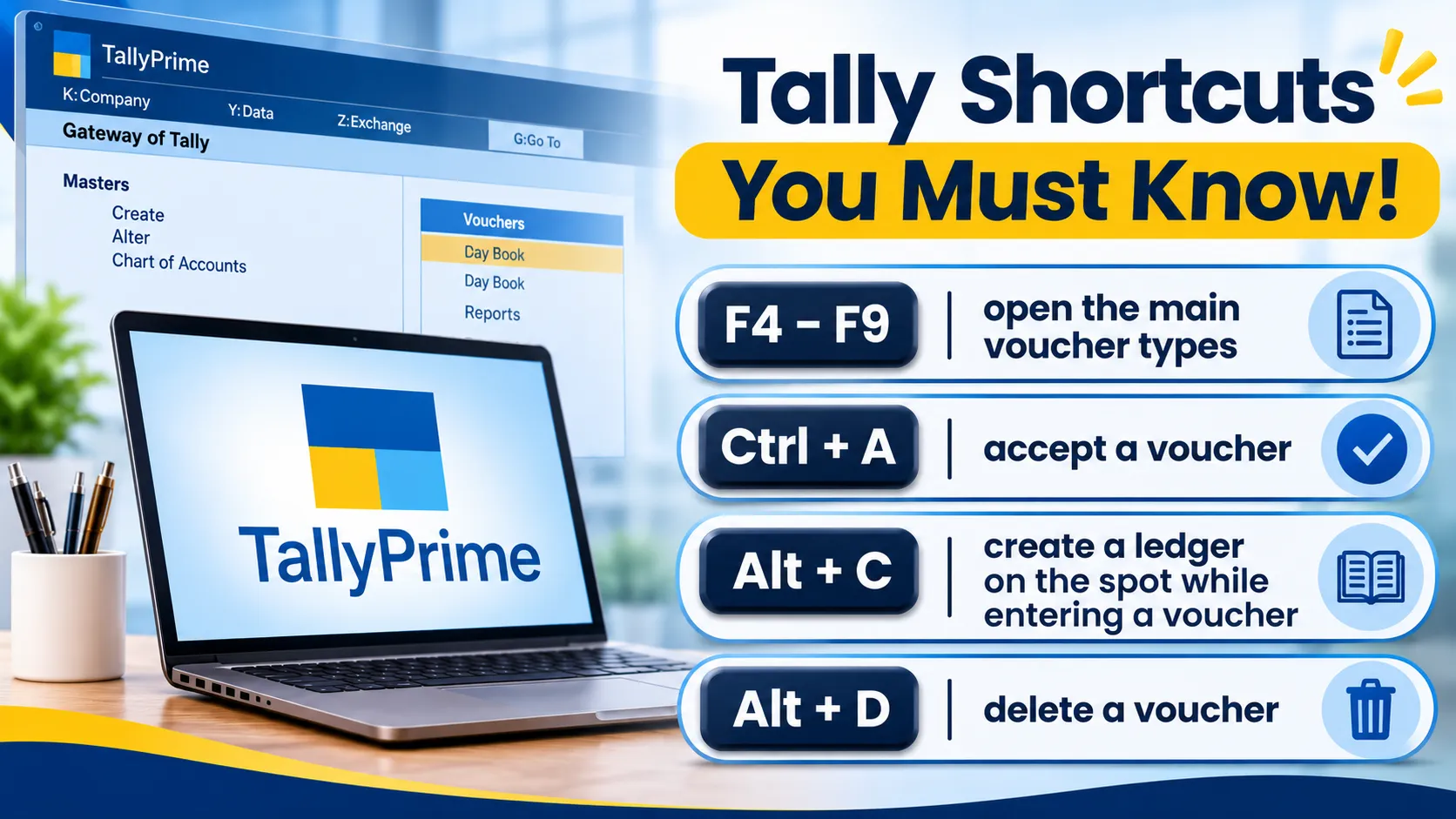
Which Tally shortcut keys should I know?
- F4 to F9: open the main voucher types
- Ctrl + A: accept a voucher
- Alt + C: create a ledger on the spot while entering a voucher
- Alt + D: delete a voucher
Knowing shortcuts signals that you have actually worked in Tally, not just read about it.
Intermediate Tally Interview Questions on GST, Cost Centres and BRS
How do you record a GST sales entry in Tally?
- Enable GST in the company features.
- Enter the GSTIN and GST details.
- Create or set up CGST, SGST, and IGST ledgers.
- Record a sales voucher with the party, item, and tax ledgers.
Use CGST + SGST for sales within the same state and IGST for sales to another state.
What is the difference between a cost centre and a cost category?
A cost centre is a department or unit where costs are tracked, and a cost category groups several cost centres for comparison.
For example, “Sales Team” and “Marketing Team” are cost centres. Both can sit under one category called “Departments”.
What is bank reconciliation (BRS) and how do you do it in Tally?
BRS means matching your Tally bank ledger with the bank statement. Entries that appear in your books but not yet in the bank, like uncleared cheques, are the usual differences.
In Tally, you open the bank reconciliation screen, tick the entries that match the statement, and enter the bank date for each. Freshers often struggle with bank reconciliation, so practise it several times before the interview.
Scenario-Based Tally Interview Questions
This is where most candidates lose marks. Slow down and speak your logic aloud.
Scenario 1: “Rent of ₹12,000 for the full year was paid in advance. Pass the entries.”
- On payment (Payment voucher): Prepaid Rent A/c Dr ₹12,000, to Bank A/c ₹12,000.
- Each month (Journal voucher): Rent Expense A/c Dr ₹1,000, to Prepaid Rent A/c ₹1,000.
Explain that prepaid rent is an asset first and becomes an expense month by month.
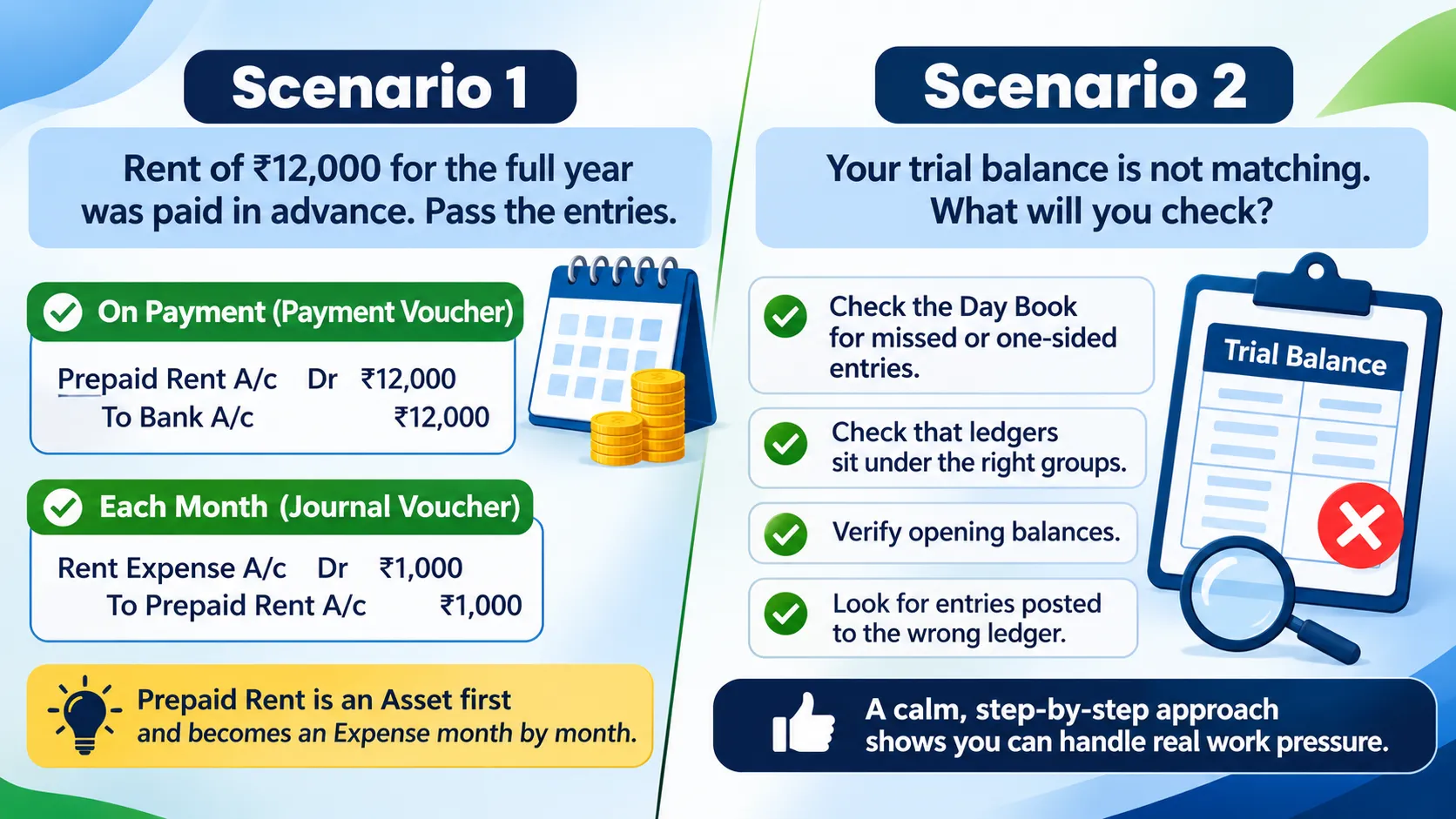
Scenario 2: “Your trial balance is not matching. What will you check?”
- Check the Day Book for missed or one-sided entries.
- Check that ledgers sit under the right groups.
- Verify opening balances.
- Look for entries posted to the wrong ledger.
A calm, step-by-step answer shows you can handle real work pressure.
How Can I Prepare for a Tally Interview in One Week?
- Days 1–2: Revise accounting basics, golden rules, and voucher types.
- Days 3–4: Create a sample company in TallyPrime and post 10–15 entries daily.
- Day 5: Practise GST invoices and bank reconciliation.
- Day 6: Solve two or three scenario questions aloud.
- Day 7: Do a mock interview with a friend or trainer.
Also keep a few honest answers ready for the usual HR questions, like “Why accounting?” and “How will you add value to our team?”
Does Learning Tally Alone Get You Hired?
Not always. Recruiters like candidates who can pair Tally with GST, Excel, and clear communication. That combination is what moves you from data entry to a proper accounts role.
If you want guided practice, ICA Edu Skills runs NSDC-certified accounting programmes, including a Tally Prime course, a Tally Prime + GST course, and the Certified Industrial Accountant (CIA) programme. Students also get monthly mock interviews, group discussions, and resume preparation, so the interview room feels familiar before the real one.
Few Tally related topics for your knowledge
- Groups In Tally Prime – Essential Concepts To Learn
- E-Invoice In Tally Prime: Complete Generation Process
- Tally Prime vs Tally ERP 9: Learn Extra In Tally Prime
- How to Use BRS in Tally Prime: A Step-by-Step Guide
- How To Handle Purchase Entry In Tally Prime
- Trial Balance In Tally Prime: A Complete Step by Step Process
Final Thoughts
Tally interviews feel hard only when your preparation is random. Learn the pattern: definitions first, live entries next, scenarios last. Practise aloud, explain the “why”, and keep your answers simple.
Your next interview might be closer than you think. If you want structured practice, you can explore Tally and accounting courses at ICA Edu Skills.
Frequently Asked Questions
1. What are the basic questions asked in a Tally interview?
Interviewers usually start with what Tally is, then ask about ledgers, groups, voucher types, shortcut keys, and GST entries. Freshers also get bank reconciliation and one or two live entries. Be ready to explain every answer with a simple example.
2. How do I prepare for a Tally interview as a fresher?
Practise daily in TallyPrime with a sample company. Revise accounting basics and golden rules, pass 10 to 15 entries aloud, and rehearse BRS and GST invoicing. Keep a one-page list of shortcuts, and run a mock interview with a friend or trainer.
3. Is Tally enough to get an accounting job?
Usually not on its own. Employers expect Tally along with accounting basics, GST knowledge, Excel, and clear communication. Tally gets your resume shortlisted, but the other skills decide whether you clear the interview and grow beyond data entry.
4. What is the salary of a Tally accountant fresher in India?
Entry-level Tally accountant roles often pay around ₹15,000 to ₹25,000 per month, according to Physics Wallah’s salary guide. Pay varies with city, employer, and skills like GST and Excel, so treat it as a rough guide, not a promise.
5. Should I learn Tally.ERP 9 or TallyPrime?
TallyPrime is the current version and the one most employers expect now. Tally.ERP 9 is older, though some firms still use it. Learn TallyPrime properly, then skim the ERP 9 differences so no interviewer can catch you off guard.

- Common Tally Interview Questions and Answers - November 28, 2026
- How to Sound More Natural When Speaking English - November 26, 2026
- Input Tax Credit: Why It Matters and How to Master It - November 24, 2026