.jpg)
















The Laptop Lifestyle: How to Pivot to a High-Paying Data Career in 2026







Summary
If you want to break into the tech industry quickly, finding the best data analytics certification is your fastest route. In 2026, companies prioritise practical skills over theoretical degrees. To land a job, choose a comprehensive data analyst course with placement that teaches SQL, Power BI, Excel, and the basics of Python, allowing you to transition seamlessly into broader data science programs.
Every single day, the world generates over 181 zettabytes of data. Let that sink in. Companies like Amazon, Zomato, and Netflix are absolutely drowning in numbers, metrics, and spreadsheets. They have the data, but they don’t know what it means.
They are desperate for Insight Architects, everyday people who can look at a messy pile of numbers and turn it into a clear business growth strategy.
If you are a college student stuck in an outdated syllabus, a fresher facing a hyper-competitive job market, or a professional feeling trapped in a dead-end 9-to-5, you have likely asked yourself: How do I pivot into a secure, high-paying tech career without spending years learning complex programming?
The answer lies in finding the best data analytics certification to kickstart your journey. Let’s break down exactly how you can claim your share of this massive job market.
Table of Contents
-
- Why Is Data Analytics the Most In-Demand Career This Year?
- What Does a Data Analyst Actually Do?
- How Much Can You Earn as a Data Analyst in India?
- What Skills Do You Actually Need to Get Hired?
- What Is the Difference Between Data Analytics and Data Science Programs?
- How Do You Choose the Best Data Analytics Certification?
- Launch Your Career with ICA Edu Skills
- Is a Data Analytics Certification Worth It Without a Tech Background?
- Top Job Roles After a Data Analytics Certification
- Conclusion
- Frequently Asked Questions
Why Is Data Analytics the Most In-Demand Career This Year?
You might see headlines talking about AI taking away traditional tech jobs. But here is the real story: AI is actually creating a massive skills gap in the data world. According to industry data, nearly 11.5 million new jobs in data science and analytics are being created.
AI can crunch numbers, but it cannot explain why a customer’s behaviour changed or how a local business should adjust its strategy. For that, companies need human brains.
| Raw Business Data | → | AI Filters It | → | You Interpret It | → | Profits Grow |
Choosing to learn data science and analytics right now is one of the most recession-resistant moves you can make. The talent shortage is so severe that India alone faces a shortfall of over 200,000 analytics professionals. This means companies are looking past traditional engineering degrees to hire certified talent.
Here are some numbers that put this in perspective:
- 1.4 million new data analytics jobs are projected globally between 2023 and 2027 (Source: industry estimates)
- NASSCOM projects a shortfall of 200,000+ data analytics professionals in India by the end of 2025
- Right now, 25,000+ data analytics roles and 124,000+ data analyst positions are listed on LinkedIn India alone.
The demand isn’t a trend. It’s a structural shift. And companies like Accenture, Deloitte, Infosys, Wipro, TCS, EY, and PwC are actively hiring month after month.
What Does a Data Analyst Actually Do?
Before you decide to pursue a certification, it helps to understand what the job actually looks like.
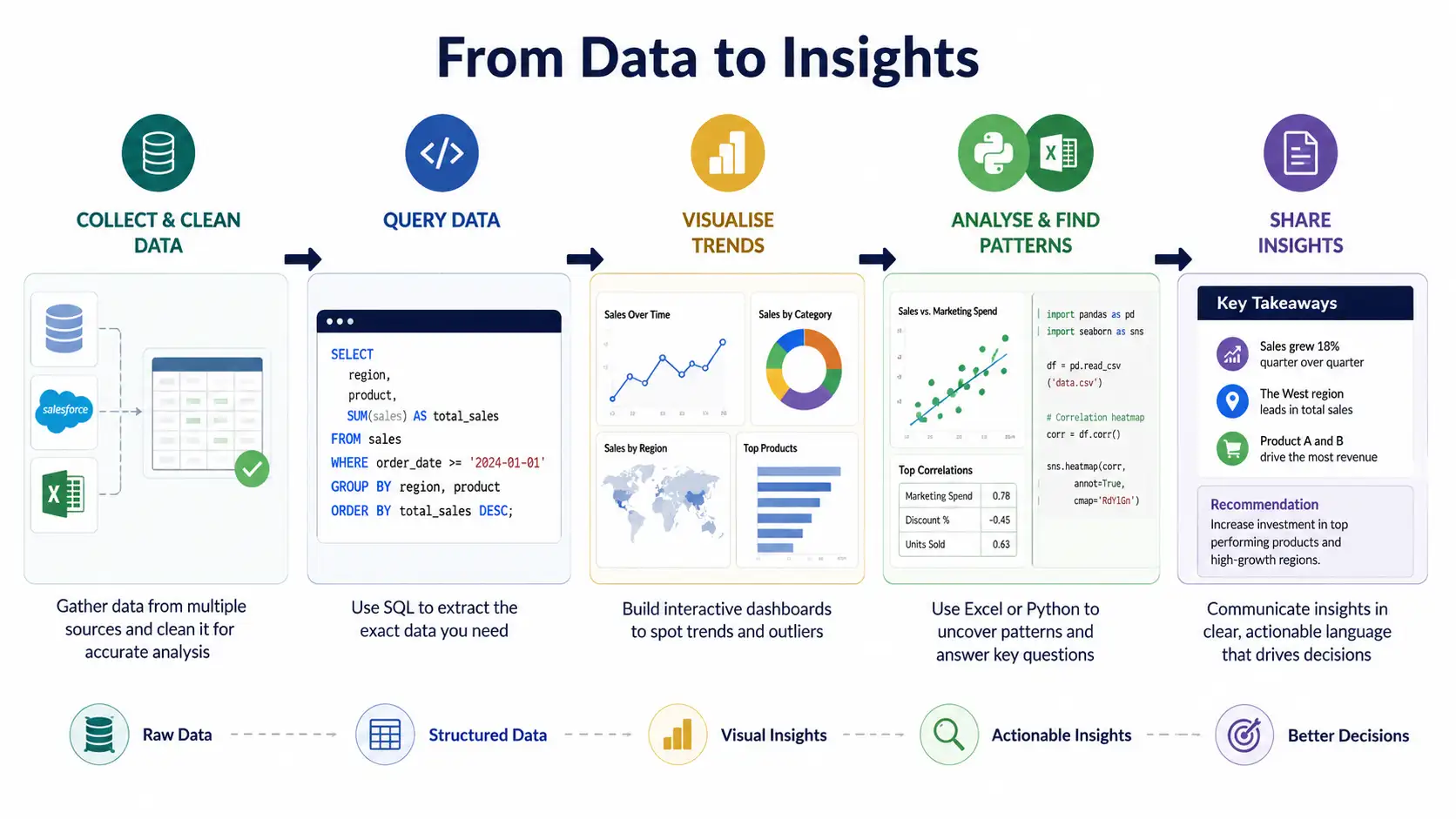
A data analyst’s day involves:
- Collecting and cleaning data from databases, CRMs, and spreadsheets
- Writing SQL queries to pull specific datasets
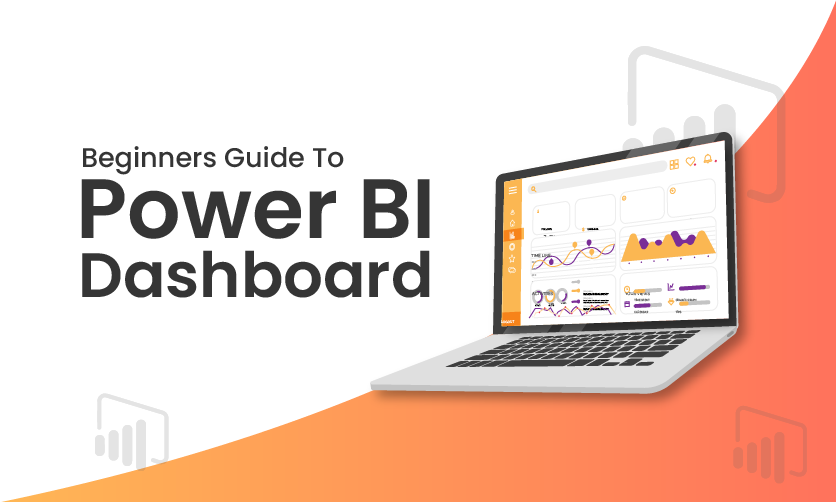
- Building dashboards in Power BI or Tableau to visualise trends
- Running analysis in Excel or Python to find patterns
- Presenting findings to managers or business teams in plain English
The best part? You don’t need to be a coder or a mathematician. You need to be curious, logical, and willing to learn the tools, which is exactly what a good certification teaches you.
How Much Can You Earn as a Data Analyst in India?
Let’s talk about the number everyone wants to know.
| Experience Level | Salary Range (per annum) |
|---|---|
| Fresher (0–1 year) | ₹3.5 – 6.5 LPA |
| Mid-level (2–4 years) | ₹7 – 12 LPA |
| Senior (5+ years) | ₹15 – 20+ LPA |
According to Glassdoor, the median data analyst salary in India is around ₹6.63 LPA, with senior analysts earning a median of ₹15 LPA. Professionals with advanced certifications earn 15–20% more than those without (Source: Simplilearn).
Cities like Bengaluru, Pune, Hyderabad, and Mumbai offer the highest starting packages, especially in tech, finance, and e-commerce sectors.
The takeaway: even as a fresher, you’re looking at a comfortable starting salary, and the ceiling is genuinely high.
What Skills Do You Actually Need to Get Hired?
This is where most students get confused. Let’s simplify it.
Core technical skills employers ask for:
- SQL: non-negotiable; shows up in 80%+ of data analyst job postings
- Excel: still the most widely used tool in analytics
- Power BI or Tableau: for data visualisation and dashboards
- Python (basics): increasingly expected, especially in tech and product companies
- Statistics fundamentals: understanding averages, distributions, and correlation
Soft skills that seal the deal:
- Clear communication (can you explain a chart to a non-technical manager?)
- Problem-solving mindset
- Attention to detail
The best data analytics certifications cover all of the above with real datasets, real projects, and guided practice.
Master MIS skills and boost your career potentialUnlock high-demand MIS job opportunities—Join our industry ready course today! |
|
| Classroom Course | Online Course |
| More Learning Options for you: Certificate in Data Science | Advanced Excel Course |
|
What Is the Difference Between Data Analytics and Data Science Programs?
This is where most beginners get confused and overwhelmed. They look up data science programs, see advanced machine learning algorithms and heavy linear algebra, and give up before they even start.
Let’s clear up the confusion with a simple comparison:
| Feature | Data Analyst | Data Scientist |
|---|---|---|
| Focus | Looks at past and present data to solve current business problems. | Builds predictive models and prototypes for the future. |
| Tools Used | Excel, SQL, Power BI, Tableau, and basic Python. | Advanced Python, R, Machine Learning, Big Data tools. |
| Skill Level | Beginner-friendly; focuses on logic and communication. | Advanced; requires deep coding and statistical math. |
| Best For | Freshers, graduates, and career changers. | Experienced developers and statisticians. |
If you’re starting or switching careers, data analytics is the smarter entry point. It’s faster to learn, easier to get hired in, and you can always move into data science roles later once you’ve built experience.
How Do You Choose the Best Data Analytics Certification?
Your resume does not need a collection of random certificates that you completed while half-asleep on your couch. Employers in today’s market look for verified, end-to-end skill acquisition.
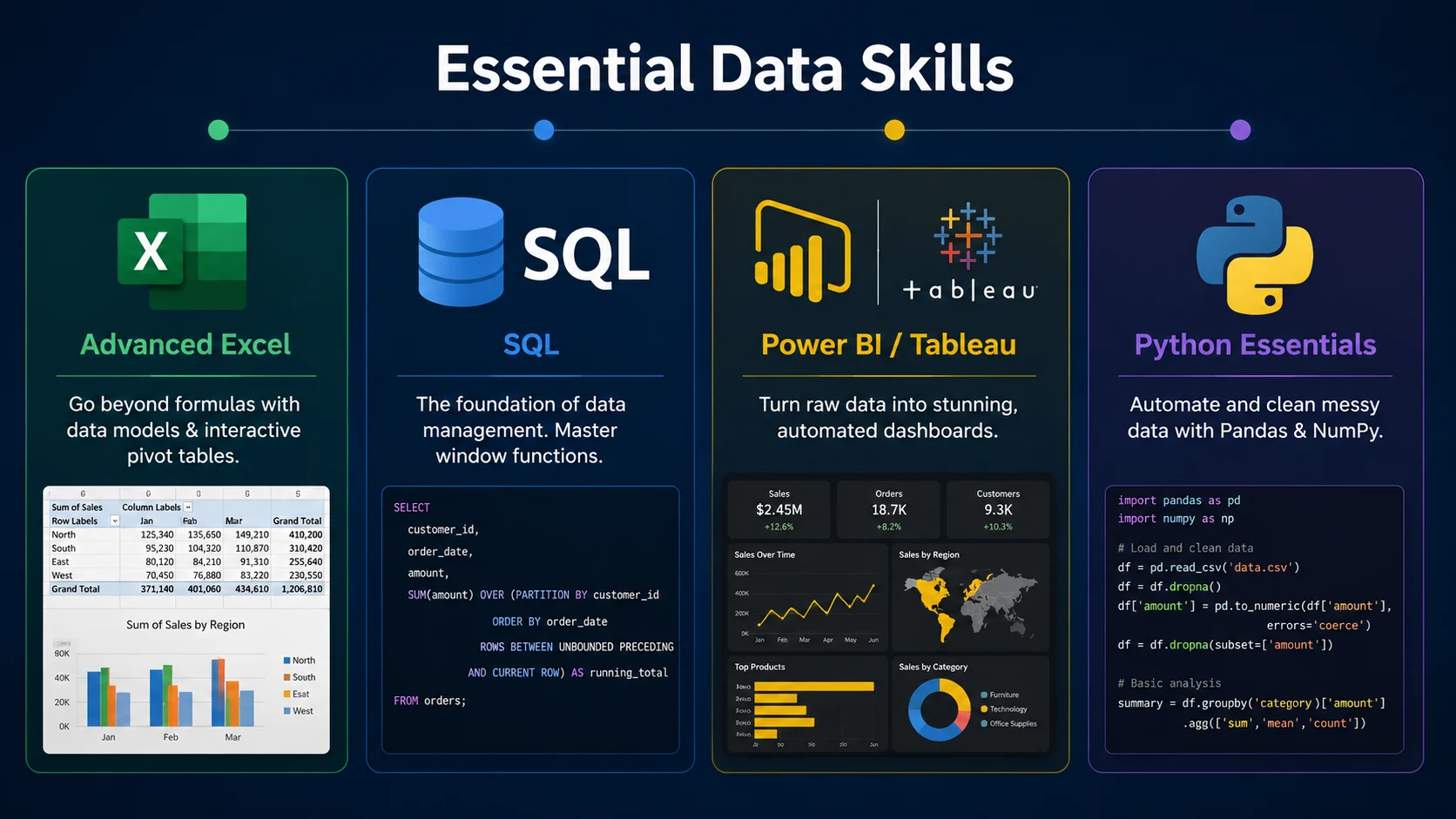
When you are searching for the best data analytics certification, make sure the curriculum focuses heavily on these core industry tools:
- Advanced Excel: Forget simple formulas; you need to master data modelling and interactive pivot tables.
- SQL (Structured Query Language): The absolute foundation of data management. If a course does not teach SQL window functions, skip it.
- Power BI or Tableau: Tools that turn ugly rows of text into beautiful, automated visual dashboards.
- Python Essentials: Basic automation scripts using libraries like Pandas and NumPy to clean messy data sets.
Launch Your Career with ICA Edu Skills
It is easy to watch online tutorials, but building a portfolio that actually catches a recruiter’s eye is a completely different ballgame. That is exactly where ICA Edu Skills bridges the gap.
Known for decades as a trusted leader in vocational and technical education, ICA Edu Skills offers a comprehensive data analyst course with placement designed specifically for real-world employment.
Why Students Choose ICA Edu Skills:
- Zero Coding Baseline: The curriculum assumes you are starting from an absolute scratch.
- Hands-on Simulation: You won’t just memorise theory; you will build live interactive dashboards and analyse real enterprise data.
- Dedicated Placement Support: With a massive network of corporate hiring partners, the program focuses heavily on mock interviews, resume optimisation, and direct job placement.
Instead of getting lost in massive online video archives, you get structured mentorship and a clear, linear path directly to an office desk.
Is a Data Analytics Certification Worth It Without a Tech Background?
Short answer: Yes
Some of the strongest data analysts come from commerce, economics, and even humanities backgrounds. Why? Because data analytics is as much about business thinking as it is about technical tools. If you understand business problems, you’re already ahead.
The tools SQL, Excel, and Power BI are learnable with practice. What you bring from your own domain (finance, marketing, operations) is actually a competitive edge, because you can contextualise data in ways pure coders can’t.
Top Job Roles After a Data Analytics Certification
Once certified, here are the roles you’ll be qualified to target:
- Data Analyst: The most common entry point
- Business Analyst: Bridges data and business strategy
- MIS Analyst: Focuses on reporting and dashboards
- Market Research Analyst: Data-driven consumer insights
- Financial Analyst: Data analysis in banking and finance contexts
- Operations Analyst: Process optimisation using data
All of these roles appear regularly on Naukri and LinkedIn, with active hiring from companies like Accenture, Capgemini, Deloitte, EY, IBM, PwC, Bajaj Finance, Wipro, and Infosys.
Few related topics for your knowledge
- 40+ Important Interview Trial Balance Questions & Answers
- Top 30 MIS Analyst Interview Questions & Answers
- Don’t Miss These 40 G Suite Interview Questions to Land Your Dream Job
- 80 Most Common Power BI Interview Questions and Answers
- Career in Management Information System: Insights, Scope, Opportunities
Conclusion
Here’s the honest reality of the Indian job market in 2026: the supply of skilled data analysts is still far below demand. NASSCOM’s own projections confirm a shortage of 200,000+ professionals. That means for a trained, certified analyst, the odds are genuinely in your favour right now.
But right now won’t last forever. As more people upskill, competition will increase. The students who move early, build real skills, and graduate with portfolios and placement support will have an edge over those who wait.
Your degree got you to the starting line. A data analytics certification moves you to the front of it.
Frequently Asked Questions
1. Can I become a data analyst if I have no coding background?
Yes, absolutely. Data analytics relies heavily on logic, structured thinking, and business intelligence tools like Power BI and Excel rather than complex software engineering. While basic SQL and Python are used for data cleaning, these can be picked up easily by beginners through structured certification programs without any prior background in computer science.
2. What is the average starting salary for a certified data analyst?
At entry-level positions, freshers holding a recognized data certification can expect a starting salary ranging from ₹4.0 to ₹6.5 Lakhs Per Annum (LPA) in India. This figure can scale up rapidly to ₹10–18 LPA as you cross three years of experience and master advanced data architecture, making it one of the highest-paying entry domains.
3. Will artificial intelligence (AI) replace data analysts soon?
No, AI will not replace data analysts; instead, it acts as a powerful assistant. While AI tools can automate repetitive scripts and basic data cleaning, human analysts are critically required to interpret data contextually, audit AI algorithms for errors, and translate complex metrics into strategic business decisions for executive boards.
4. How long does it take to get a job in data analytics?
On average, a dedicated student can become job-ready within 4 to 7 months. This timeline includes mastering core databases like SQL, data visualisation suites, and assembling a professional portfolio of real-world projects. Choosing a course with built-in placement assistance significantly accelerates your interview pipeline.
5. Is a data analytics certificate worth it compared to a university degree?
Yes. Modern recruiters heavily prioritise verified skills, portfolio quality, and hands-on tool competence over traditional, theoretical university degrees. A specialised certification program offers a fast-tracked, practical curriculum aligned directly with current market tools, saving you both time and high tuition fees.