.jpg)















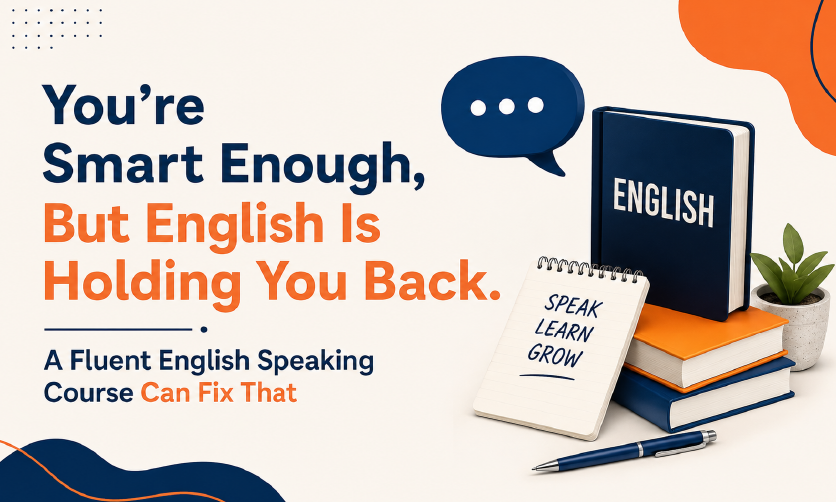
Best English Speaking Course: Why Fluency Beats Your Degree







Summary
The best English-speaking course blends daily speaking practice, live feedback, and real workplace scenarios, interviews, group discussions, and presentations instead of grammar drills alone. For Indian students and professionals, prioritise courses with live practice sessions, personalised correction, and placement-linked speaking modules that build confidence employers actually notice in interviews.
You cleared the technical round. Your resume looks sharp. Your subject knowledge is solid.
Then the HR round happens. “So, tell me about yourself.”
You know the answer in your head, in your own language; it’s perfect. But the moment you try to say it in English, the words scatter. You pause. You repeat yourself. You watch the interviewer’s face change.
If this has ever happened to you, here’s the truth nobody tells you: it’s not an intelligence problem. It’s a practice problem. And practice problems have solutions.
Table of Contents
- Why Does Speaking English Confidently Matter More Than You Think?
- What Actually Makes an English Speaking Course The Best One?
- Self-Study vs a Structured Speaking Course
- “I Already Know English, I Just Can’t Speak” Sound Familiar?
- How a Focused English Language Program Actually Builds Confidence
- Conclusion
- Frequently Asked Questions
Why Does Speaking English Confidently Matter More Than You Think?
It’s easy to assume recruiters mainly test your technical skills. They don’t stop there.
Here’s what the data actually shows:
- India’s Graduate Skill Index 2025 (Mercer Mettl) found that Indian graduates show communication-skill employability of just around 55%, meaning nearly half of job-ready candidates still struggle to express themselves clearly and confidently.
- NITI Aayog’s 2025 report on State Public Universities flags weak English communication as one of the biggest employability gaps for Indian graduates even when their subject knowledge is strong.
- On the EF English Proficiency Index 2025, which ranked 123 countries and regions, India placed 74th despite English being an official language used across Indian education, government, and business.
Put simply: you can be technically brilliant and still lose the opportunity in the two minutes it takes to introduce yourself badly.
That’s exactly the gap a good spoken English course is built to close.
What Actually Makes an English Speaking Course The Best One?
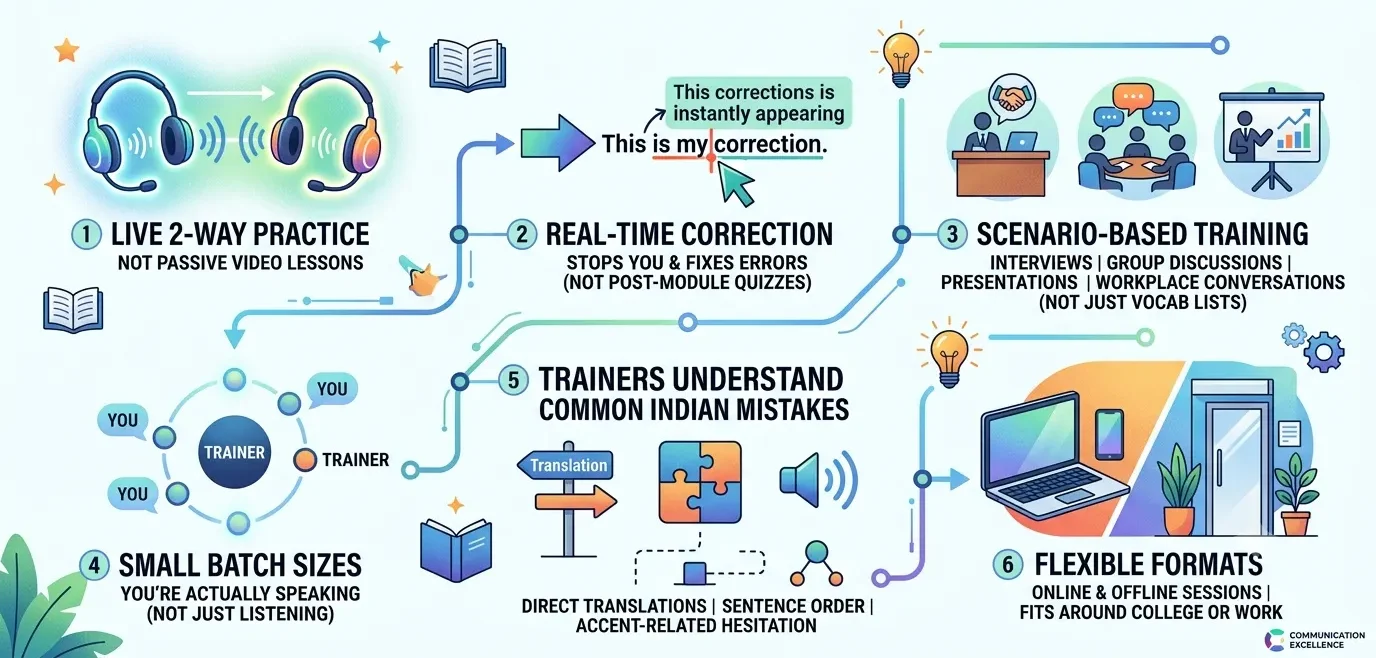
Not every course that promises fluency delivers it. Here’s what separates a course that actually works from one that just fills your evenings:
- Live, two-way speaking practice, not just recorded video lessons you watch passively
- Real-time correction: a trainer who stops you mid-sentence and fixes the error there and then, not a quiz score at the end of a module
- Scenario-based training practice for interviews, group discussions, presentations, and everyday workplace conversations, not just vocabulary lists
- Small batch sizes, so you’re actually speaking every session, not just listening.
- Trainers who understand common mistakes Indian speakers make: direct translation habits, sentence order, and accent-related hesitation
- Flexible formats: a mix of online and offline sessions that fit around college or work
If a course is missing most of these, it’s teaching English. It’s not teaching you to speak it.
Self-Study vs a Structured Speaking Course
Consider two students preparing for the same campus placement drive.
Student A spends three months watching English-learning videos on his phone. He can recite grammar rules and has a strong vocabulary. But when the interviewer asks a follow-up question he didn’t expect, he freezes; he’s never had to respond to a real person in real time.
Student B joins a structured spoken English program with weekly mock interviews and group discussion practice. Her grammar isn’t perfect either. But she’s used to thinking on her feet in English, handling interruptions, and recovering from mistakes mid-sentence without panicking.
Guess who sounds more employable in the interview room?
Fluency isn’t about knowing more words. It’s about reps the number of times you’ve actually had to speak under a bit of pressure.
“I Already Know English, I Just Can’t Speak” Sound Familiar?
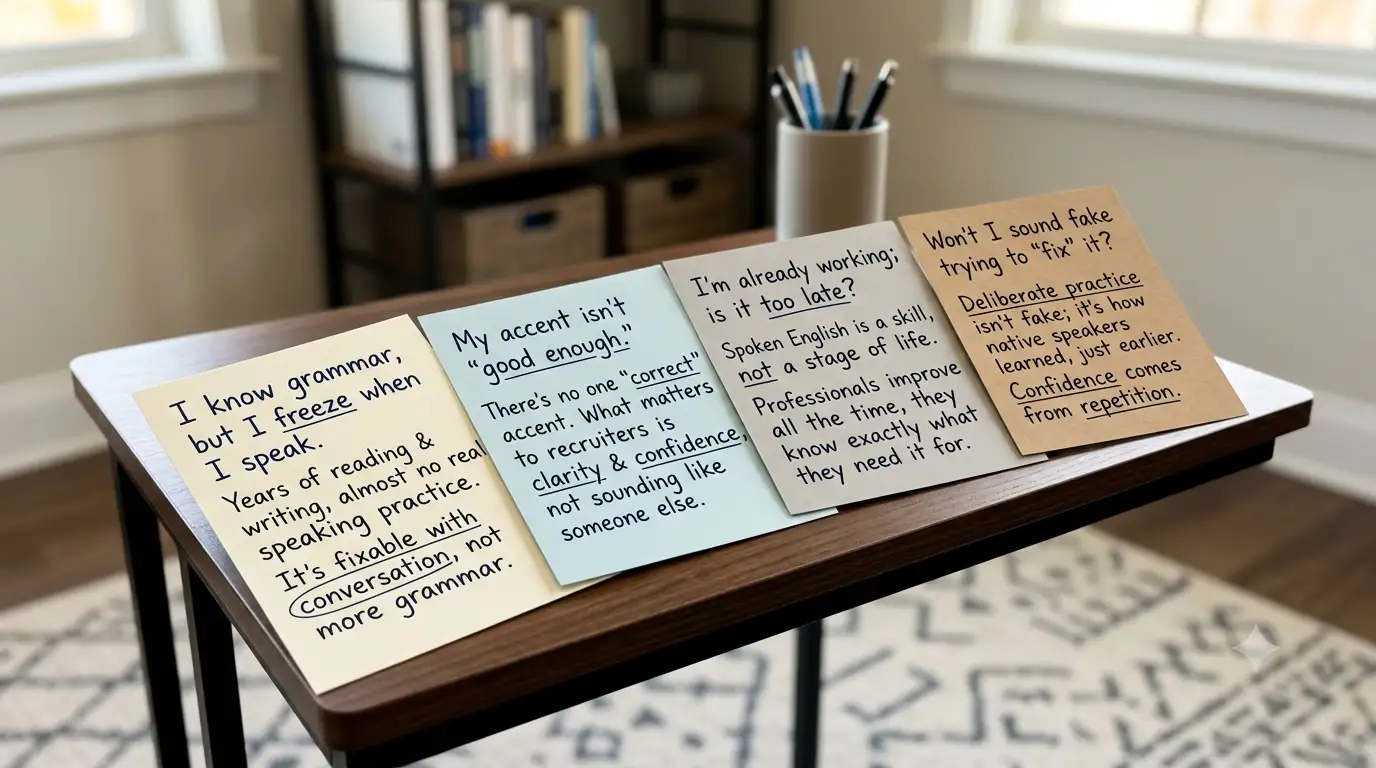
Almost every student who walks into a spoken English class says some version of this. Here are the doubts we hear most, and the truth behind each one:
“I know grammar, but I freeze when I actually have to speak.” This is the most common gap in Indian English education: years of reading and writing English, with almost no real speaking practice. It’s fixable with consistent conversation practice, not more grammar study.
“My accent isn’t ‘good enough.’ There’s no single “correct” Indian accent to erase. What matters to recruiters is clarity and confidence, not sounding like someone from another country.
“I’m already working; is it too late to fix this?” Spoken English is a skill, not a stage of life. Professionals in their 30s and 40s improve their fluency all the time, usually faster than students, because they already know exactly which real situations they need it for.
“Won’t I sound fake trying to ‘fix’ my English now?” Practising deliberately isn’t fake; it’s exactly how native speakers learned too, just earlier in life. Confidence comes from repetition, not from being a “natural.”
Online English Speaking Classes vs Offline: Which Should You Choose?
| Factor | Online English Speaking Classes | Offline / Classroom Courses |
|---|---|---|
| Convenience | Learn from home, fits around college or job timings | Fixed schedule, requires travel |
| Peer practice | Depends on batch size and video engagement | Easier to build a speaking peer group |
| Feedback speed | Live, if the platform uses real trainers (not just recorded content) | Immediate, in-person correction |
| Best for | Working professionals, students in smaller towns, tight schedules | Students who focus better with in-person accountability |
| Cost | Often more affordable for shorter modules | Usually higher due to infrastructure |
The honest answer: neither format is automatically better. What matters is whether you’re actually speaking out loud every single session online or offline.
How a Focused English Language Program Actually Builds Confidence
Most people assume a spoken English course is just extra vocabulary and grammar revision. The stronger programs work differently; they treat speaking as a skill you build the same way you’d build fitness: through repeated, structured reps in situations that mirror real life.
At ICA Edu Skills, the Cambridge English program is built around this idea, and it doesn’t work in isolation; every course pairs communication training with the same soft-skill infrastructure students actually need for interviews:
- Monthly mock interviews, so speaking under pressure becomes familiar instead of frightening
- Group discussion practice, which forces you to think and respond in real time, not just recite prepared answers
- Resume preparation sessions, so what you say in an interview actually matches what’s on paper
- SOBO (Speak Out Bowl Out) sessions are a format designed specifically to get students speaking spontaneously in front of others, again and again, until hesitation stops being the default
The point isn’t just to “know” English better. It’s to walk into an interview room, a group discussion, or a client call and not lose your train of thought the moment the pressure is on.
Speak with Confidence. Communicate with Impact
Master Listening, Speaking, Reading & Writing with ICA’s Cambridge English Program, and open doors to better academics, careers, and everyday conversations.
Conclusion
Your degree gets you shortlisted. Your English fluency often decides whether you get hired.
The gap between “I understand English” and “I can speak it confidently under pressure” is exactly what a structured spoken English course is meant to close not through more grammar rules, but through real practice, real correction, and real scenarios.
If you’ve been putting off working on your spoken English because you’re not sure where to start, that hesitation is usually the biggest barrier, not your actual English. A short conversation with a counselor about ICA Edu Skills’ English language program is a low-pressure way to figure out where you stand and what you’d actually need to work on.
Few related topics for your knowledge
Frequently Asked Questions
1. What is the best way to learn English speaking quickly?
Consistent daily speaking practice combined with structured feedback works fastest. Join a course that gives you live conversation practice, corrects errors in real time, and puts you in real scenarios like interviews and group discussions, not just grammar worksheets or recorded videos alone.
2. How many months does it take to become fluent in English speaking?
Most learners notice improvement within 8–12 weeks of regular practice, though real fluency thinking and responding naturally usually takes 4–6 months of consistent speaking practice. Your starting level and how often you actually speak (not just study) affect the timeline.
3. Is a spoken English course useful for job interviews?
Yes. Recruiters assess communication throughout the interview, not only in technical rounds. A spoken English course trains you for real formats: self-introduction, HR questions, group discussions, so you respond with clarity instead of memorised, rehearsed answers.
4. Can a beginner with weak grammar join an English speaking course?
Absolutely. Most spoken English courses are built for beginners and develop speaking confidence alongside grammar, not after it. Waiting until your grammar feels “perfect” before you start speaking is actually the biggest reason most learners never become fluent.
5. What is the fee for an English speaking course in India?
Fees vary widely by duration, mode (online or classroom), and level, from budget-friendly online programs to comprehensive classroom courses with mock interviews and certification. Compare curriculum depth and weekly speaking-practice hours, not just price, before enrolling.
- Best English Speaking Course: Why Fluency Beats Your Degree - August 21, 2026
- SAP Production Planning Certification: 5 Truths Nobody Tells You - August 14, 2026
- SAP Sales and Distribution Certification: Your Path to a High-Demand SAP SD Career - August 10, 2026