.jpg)
















25+ SAP MM Interview Questions & Answers: Cheat Sheet You Need Today







Mastering an SAP MM (Materials Management) interview in 2026 isn’t about reciting definitions of a Purchase Order. Companies are no longer looking for T-code walkers, they are looking for Solution Architects.
Whether you are a fresher or a seasoned consultant, interviewers today test four specific pillars: Process Logic (P2P), Configuration Depth (SPRO), Integration (FI/SD), and Troubleshooting. If you can’t explain the accounting entry during a Goods Receipt or why a Release Strategy isn’t triggering, a certification won’t save you.
This guide moves beyond classroom theory. We have compiled real-world implementation and support project questions that separate the experts from the beginners.
Table of Contents
- What Interviewers Actually Test in SAP MM
- BASIC LEVEL QUESTIONS
- INTERMEDIATE LEVEL QUESTIONS
- ADVANCED LEVEL QUESTIONS
- SCENARIO-BASED QUESTIONS
- 17) PO price is not getting picked automatically. How do you troubleshoot?
- 18) MRP is not generating purchase requisitions for a material. What could be the reasons?
- 19) The user says stock is available but MRP still creates PR. Why?
- 20) Invoice is blocked due to price or quantity variance. How do you handle it?
- 21) A PO was already released but then modified. How does release strategy behave?<
- 22) Business wants Source List to be mandatory for procurement. How would you configure it?
- 23) Subcontracting GR is failing due to component shortage. How do you resolve it?
- 24) Stock in transit is not reflecting correctly in STO. What could be the reason?
- 25) Business wants to split material valuation between imported and local stock after go-live. What do you do?
- Common Mistakes SAP MM Candidates Make
- How to Prepare for SAP MM Interviews: Your Action Plan
- Conclusion
- Frequently Asked Questions
What Interviewers Actually Test in SAP MM
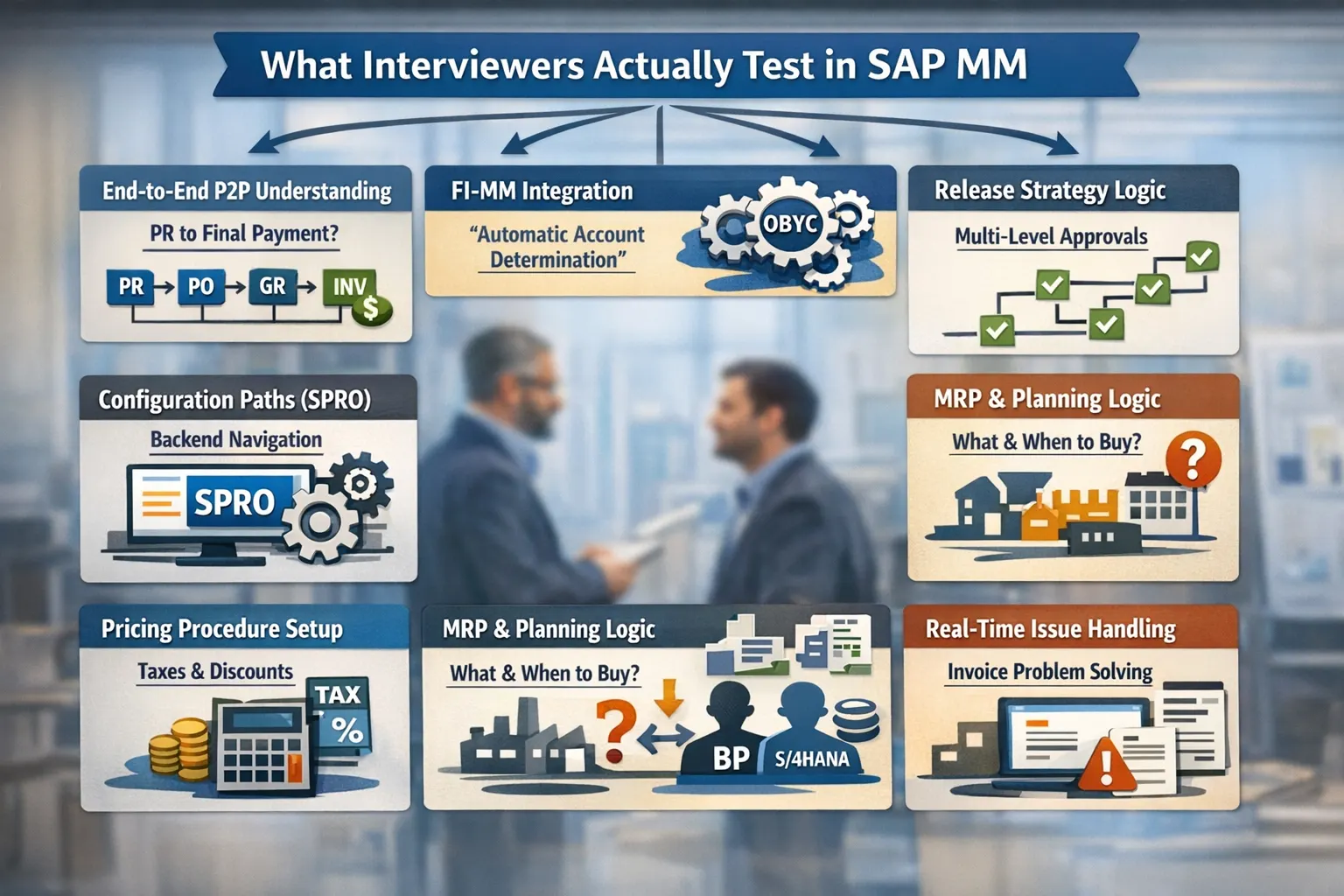
Before diving into the questions, you must understand the “Interview Blueprint.” When an interviewer asks a question, they are secretly checking your grip on these areas:
- End-to-End P2P Understanding: Can you trace a requirement from a Purchase Requisition (PR) to the final Payment?
- FI-MM Integration Knowledge: Do you understand the “Automatic Account Determination” (OBYC) logic?
- Configuration Paths (SPRO): Can you navigate the backend logic without relying on a cheat sheet?
- Release Strategy Logic: Do you know how to handle multi-level approvals for high-value procurement?
- Pricing Procedure Setup: Can you configure schemas with taxes, discounts, and freight?
- MRP & Planning Logic: How does the system decide “what” to buy and “when”?
- S/4HANA Differences: Are you aware of Business Partners (BP) and the simplified data model?
- Real-time Issue Handling: How do you react when a user says, “I can’t post this invoice due to a price variance”?
BASIC LEVEL QUESTIONS
1) Explain SAP MM and its role in the business.
In my experience, SAP MM manages the complete procurement and inventory management cycle. I’ve worked extensively on the Procure-to-Pay (P2P) process, starting from purchase requisition to invoice verification. MM ensures material availability, controls procurement costs, and integrates tightly with FI for accounting entries and with SD and PP for demand and production planning.
Follow-up Question 1: How does MM integrate with FI?
I’ve handled FI-MM integration mainly through automatic account determination in OBYC. At the time of Goods Receipt, the system posts inventory and GR/IR entries automatically, and during MIRO, it clears GR/IR and posts vendor liability.
Follow-up Question 2: What is the P2P cycle?
The P2P cycle includes PR → PO → Goods Receipt → Invoice Verification → Payment. I’ve configured and supported this full flow in multiple projects.
2) What are the key master data objects in SAP MM?
The key master data I work with are Material Master, Business Partner (Vendor), Purchasing Info Record, Source List, and Quota Arrangement. In implementations, I ensure all organizational views are properly extended, especially plant and purchasing organization levels.
Follow-up Question 1: Which data is plant-specific?
Material Master MRP and storage views are plant-specific. Valuation can also be plant-level depending on configuration.
Follow-up Question 2: What is the most common master data mistake?
Wrong valuation class or missing purchasing organization data, which causes account determination or PO creation errors.
3) Explain PR vs PO.
In my projects, PR is an internal document generated manually or via MRP. PO is an external legally binding document sent to vendors. Buyers convert PRs into POs after source determination and price validation.
Follow-up Question: Can PR be created automatically?
Yes, I’ve configured MRP runs (MD01/MD02) to automatically generate PRs based on demand and planning parameters.
4) What happens during the Goods Receipt?
During GR (movement 101), the system updates stock and posts accounting entries. For stock materials, inventory is debited and GR/IR is credited. I always validate movement types carefully because incorrect ones impact accounting.
Follow-up Question: What changes for consumables?
For consumables, the system directly debits the cost center instead of inventory.
5) What are special stocks?
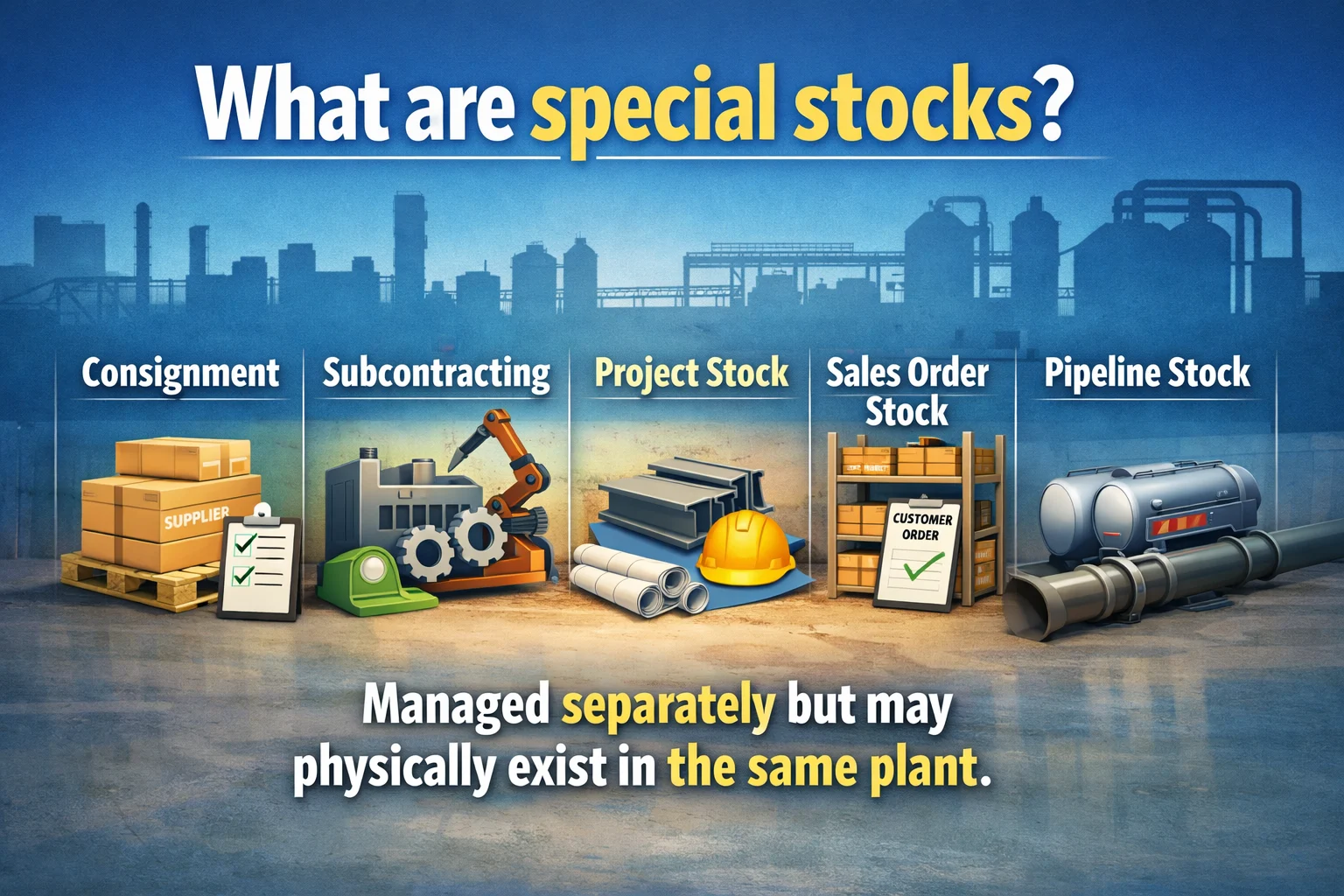
Special stocks include Consignment, Subcontracting, Project stock, Sales order stock, and Pipeline stock. These stocks are managed separately but may physically exist in the same plant.
Follow-up Question: Which indicator is used for consignment?
Consignment uses a special stock indicator “K”.
INTERMEDIATE LEVEL QUESTIONS
6) Explain the subcontracting process end-to-end.
In subcontracting, I create a PO with item category L. Components are issued to vendors using movement 541. Vendor returns finished goods, and the system automatically adjusts component consumption. I ensure BOM is properly maintained to avoid errors.
Follow-up Question: What accounting entries occur?
Component stock is credited and finished material stock is debited at GR.
7) Explain the consignment process.
In consignment, material is received without accounting impact. Ownership remains with the vendor. Accounting is posted only when we withdraw stock using movement 411K.
Follow-up Question: When is the vendor paid?
Vendor is paid after settlement of consumed quantity.
8) How is pricing determined in PO?
Pricing is determined through condition technique. I’ve configured condition types, access sequences, and pricing schema in SPRO. The system picks prices from info records or contracts.
Follow-up Question: What if price is not determined?
I check schema assignment, info record validity, and condition records.
Rule the Market with Professional SAP Training |
|||
| SAP Certification Courses | |||
| Explore All SAP Courses SAP FICO Course | SAP MM Course | SAP PP Course | SAP SD Course |
|||
9) Explain release strategy configuration.
I configure release strategy using class type 032 and characteristics like plant and value. Release codes are assigned to approvers. Strategy triggers based on defined values.
Follow-up Question: When does release reset?
If value increases and reset indicator is active.
10) What is automatic account determination?
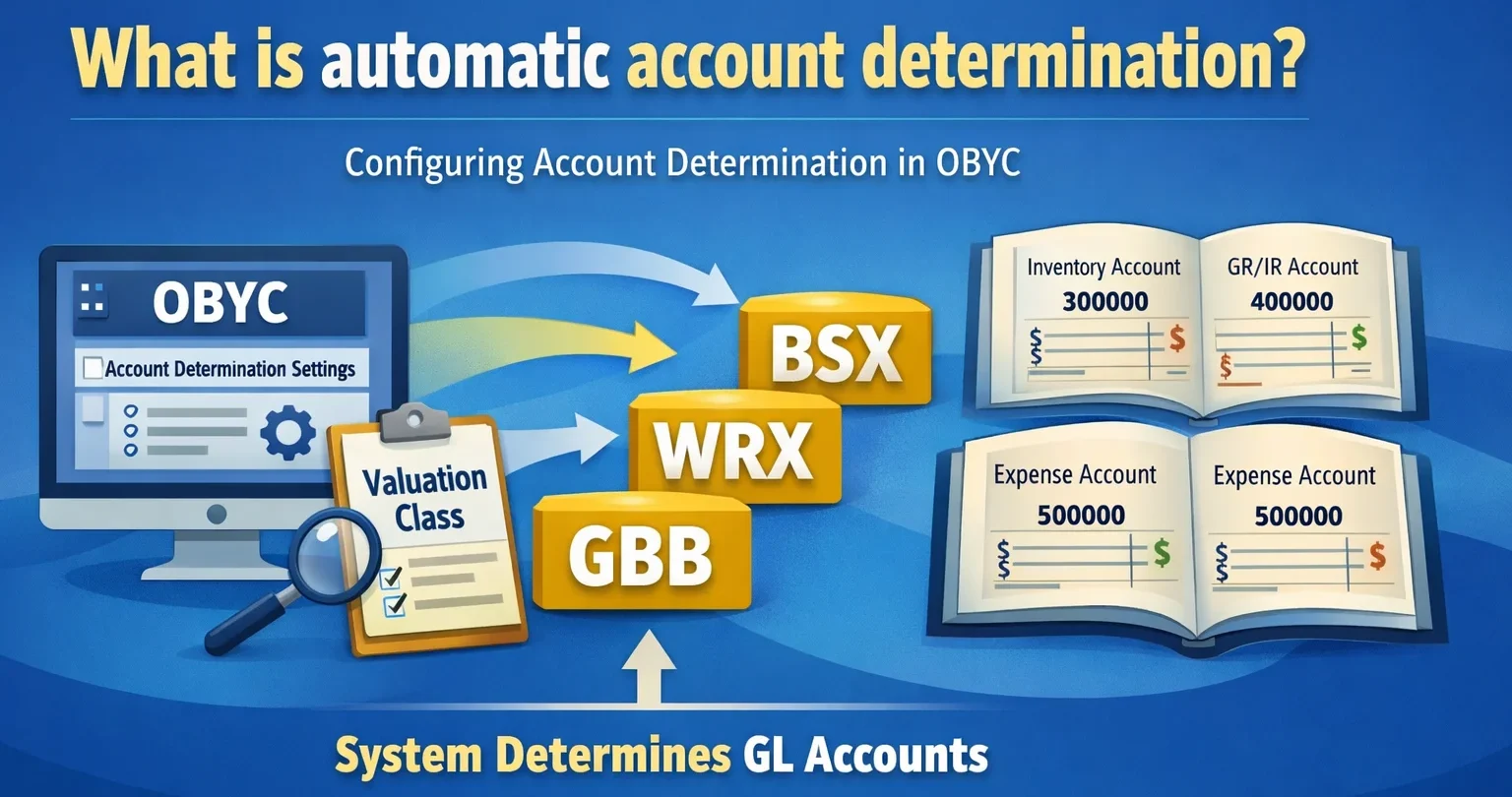
Account determination is configured in OBYC. The system determines GL accounts using valuation class and transaction keys like BSX, WRX, and GBB.
Follow-up Question: What causes account determination error?
Incorrect valuation class or missing GL account in OBYC.
11) What is MRP?
MRP calculates material requirements based on demand and generates PR or planned orders. I configure MRP types, lot size, and procurement type in material master.
Follow-up Question: Why would MRP not generate PR?
Possible reasons: wrong MRP type, no planning file entry, or incorrect procurement type.
12) What is Split Valuation?
Split valuation allows the same material to have multiple valuation types like imported and local. I configure valuation categories and types carefully before transactions begin.
Follow-up Question: Can it be activated later?
No, not after transactional data exists.
Few SAP related topics for your knowledge
- Accounts Receivable Process In SAP:A Step-by-Step Process
- SAP FICO Enterprise Structure: A Comprehensive Guide
- Accounts Payable Process in SAP: Step by Step Guide
- Vendor Reconciliation in SAP: Definition, Steps, Scenario, Advantages
- SAP Order To Cash Process: Optimizing Financial Flows
- Unveiling The Difference Between SAP And ERP: Essential Factors To Consider
ADVANCED LEVEL QUESTIONS
13) Explain Material Ledger.
Material Ledger supports actual costing and multi-currency valuation. In S/4HANA, it’s mandatory. I’ve worked on price difference settlement during period-end closing.
Follow-up Question: Difference between MAP and Standard price?
Standard price remains fixed; MAP changes with each GR.
14) Explain Invoice Verification process.
In MIRO, the system performs a 3-way match between PO, GR, and Invoice. If variance exceeds tolerance (configured in OMR6), invoice is blocked.
Follow-up Question: How do you release blocked invoices?
Using MRBR after validating variance.
15) What is the confirmation control key?
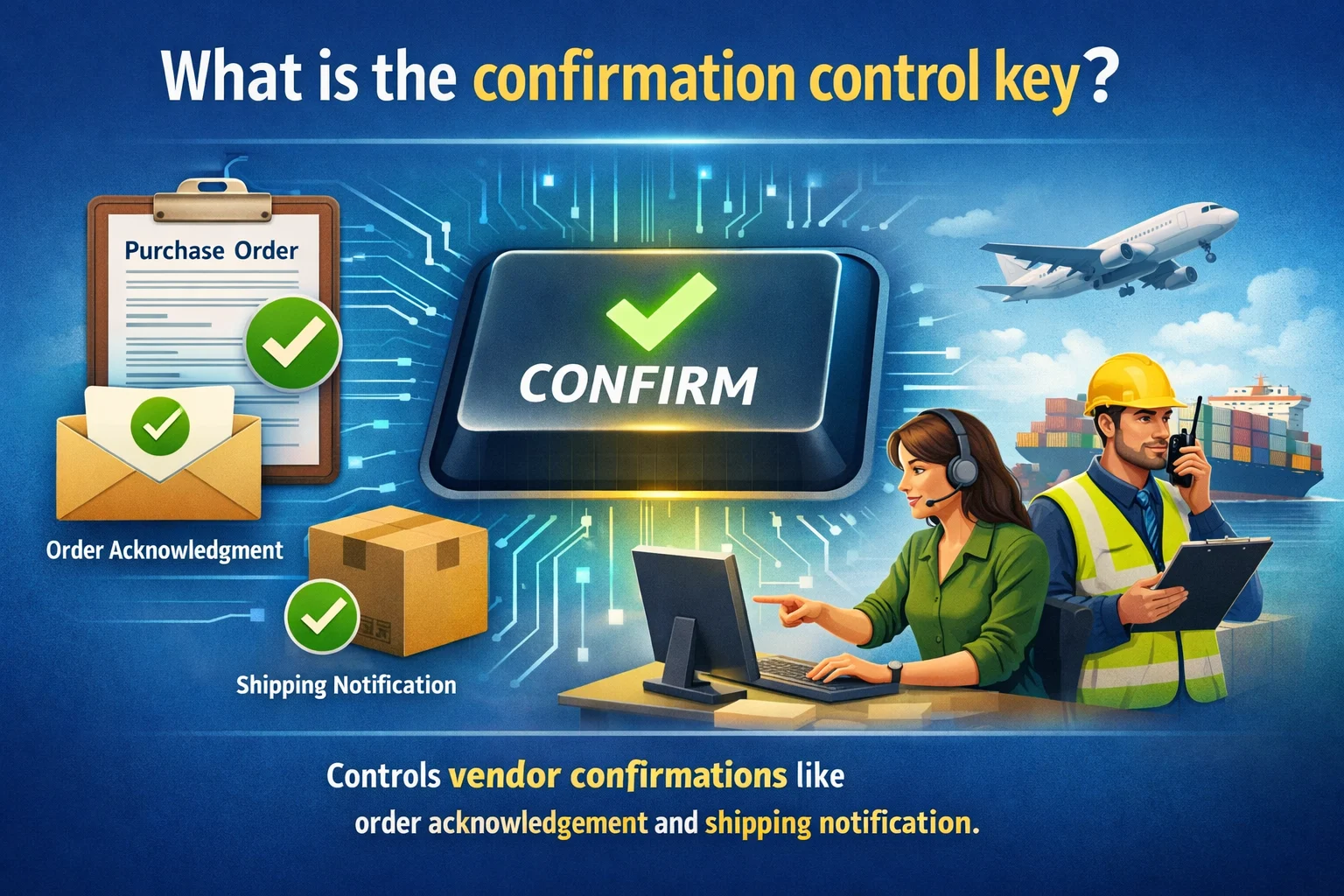
Confirmation control key controls vendor confirmations like order acknowledgment and shipping notification.
Follow-up Question: What if confirmation is mandatory?
PO cannot proceed without required confirmation.
16) Explain Source List and Quota Arrangement.
Source List defines approved vendors. Quota Arrangement distributes procurement among vendors based on quota percentage.
Follow-up Question: When is source list mandatory?
When configured in plant settings.
SCENARIO-BASED QUESTIONS
17) PO price is not getting picked automatically. How do you troubleshoot?
When pricing is not determined in a PO, I troubleshoot systematically. First, I check whether a valid Purchasing Info Record or Contract exists for the vendor–material combination and verify the validity dates. Then I review the pricing schema assigned to the purchasing organization and vendor schema group. I also check whether condition records are maintained correctly and whether the access sequence is able to find the record based on key fields like vendor, material, and purchasing organization. If everything is maintained but still not working, I analyze the pricing procedure determination configuration.
Follow-up Question 1: Where do you check schema determination?
I verify schema group assignments in the vendor master and purchasing organization configuration, then check pricing procedure determination in SPRO under Purchasing → Conditions.
Follow-up Question 2: What is a common mistake in this issue?
The most common issue is missing condition records or incorrect validity dates in the info record.
18) MRP is not generating purchase requisitions for a material. What could be the reasons?
I first check the material master MRP views to confirm the MRP type, procurement type, and lot size are correctly maintained. Then I review MD04 to see if there is actual demand. I verify whether a planning file entry exists and ensure the material is included in the MRP run. I also check if the source of supply is missing when mandatory source determination is active.
Follow-up Question 1: How do you check planning file entry?
I use MD21 or check MRP status in the material master to confirm whether the material is flagged for planning.
Follow-up Question 2: Can procurement type affect this?
Yes, if procurement type is set to in-house production instead of external procurement, MRP will create planned orders instead of purchase requisitions.
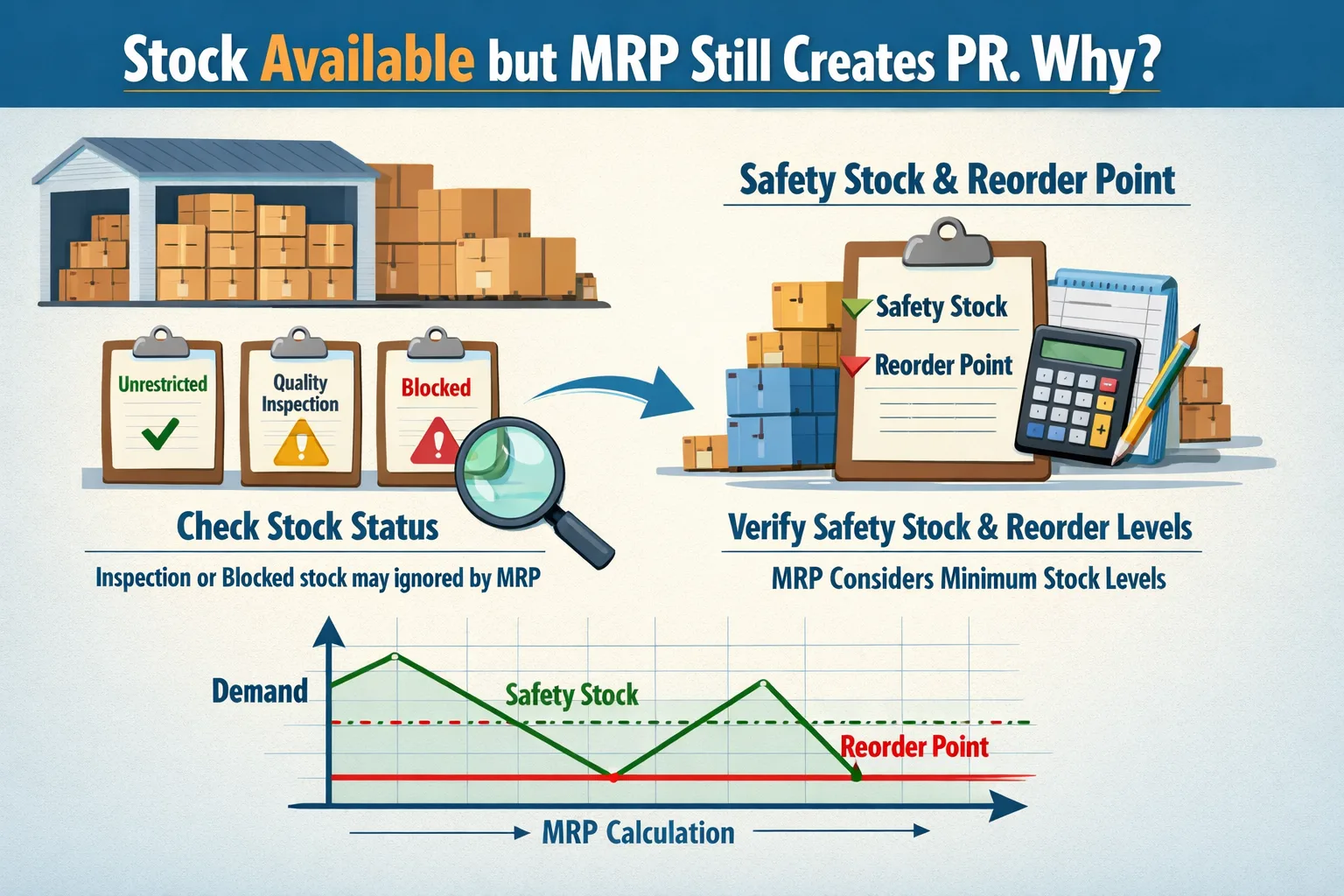
19) The user says stock is available but MRP still creates PR. Why?
I check whether stock is in unrestricted use. If stock is in quality inspection or blocked status, MRP may ignore it depending on configuration. I also verify safety stock and reorder point settings, as MRP considers these while calculating net requirements.
Follow-up Question: Where do you check stock type?
In the stock overview transaction, I review stock categories like unrestricted, quality, or blocked.
20) Invoice is blocked due to price or quantity variance. How do you handle it?
First, I compare PO, GR, and Invoice quantities to identify the variance. Then I check tolerance limits configured in OMR6. If the variance is within acceptable limits but still blocked, I analyze whether it requires manual release. After validating with business, I use MRBR to release the blocked invoice. If the variance is genuine, I coordinate correction through credit memo or PO amendment.
Follow-up Question 1: What is 3-way matching?
It is the comparison of Purchase Order, Goods Receipt, and Invoice to ensure quantity and price consistency before posting.
Follow-up Question 2: Can tolerance limits be changed?
Yes, they can be adjusted in configuration, but this must be approved carefully as it impacts financial control.
21) A PO was already released but then modified. How does release strategy behave?
If release reset is configured, any significant change, such as value increase—will trigger the release strategy again. I check whether the Release Indicator Changeability setting allows modifications without reset. If reset is active, the PO must go through the approval process again.
Follow-up Question 1: Where is reset configuration maintained?
It is maintained in the release indicator configuration within the release procedure setup in SPRO.
Follow-up Question 2: What type of changes trigger reset?
Value changes, quantity increases, or changes in key fields like plants.
22) Business wants Source List to be mandatory for procurement. How would you configure it?
I would activate the “Source List Requirement” indicator at the plant level in configuration. Once activated, the system will only allow PR or PO creation if a valid source list entry exists for that material and plant. I ensure that proper source list entries are maintained before activating this setting in production.
Follow-up Question: What happens if no source list exists?
The system will block procurement and display an error during PR or PO creation.
23) Subcontracting GR is failing due to component shortage. How do you resolve it?
I first checked the stock overview to verify whether components were issued to the vendor using movement 541. If stock is insufficient, I arrange transfer posting or additional component issues. I also verify BOM accuracy because incorrect component quantities in BOM can cause shortage errors.
Follow-up Question: Which movement type is used for component issues?
Movement type 541 is used to send components to subcontractors.
24) Stock in transit is not reflecting correctly in STO. What could be the reason?
I checked whether the correct movement types were used, 351 for goods issue and 101 for goods receipt. If one side is missing, stock in transit will not update properly. I also verify whether delivery document processing was completed in inter-company scenarios.
Follow-up Question: Is billing involved in all STOs?
No, billing is involved only in inter-company STO between different company codes.
25) Business wants to split material valuation between imported and local stock after go-live. What do you do?
Split valuation cannot be activated after transactional data exists. I explain this constraint to business. If required, we create a new material with split valuation activated and gradually phase out the old material. Early design decisions are critical for valuation strategy.
Follow-up Question: Why can’t it be activated later?
Because valuation category impacts accounting structure, and historical postings cannot be retrofitted.
Common Mistakes SAP MM Candidates Make
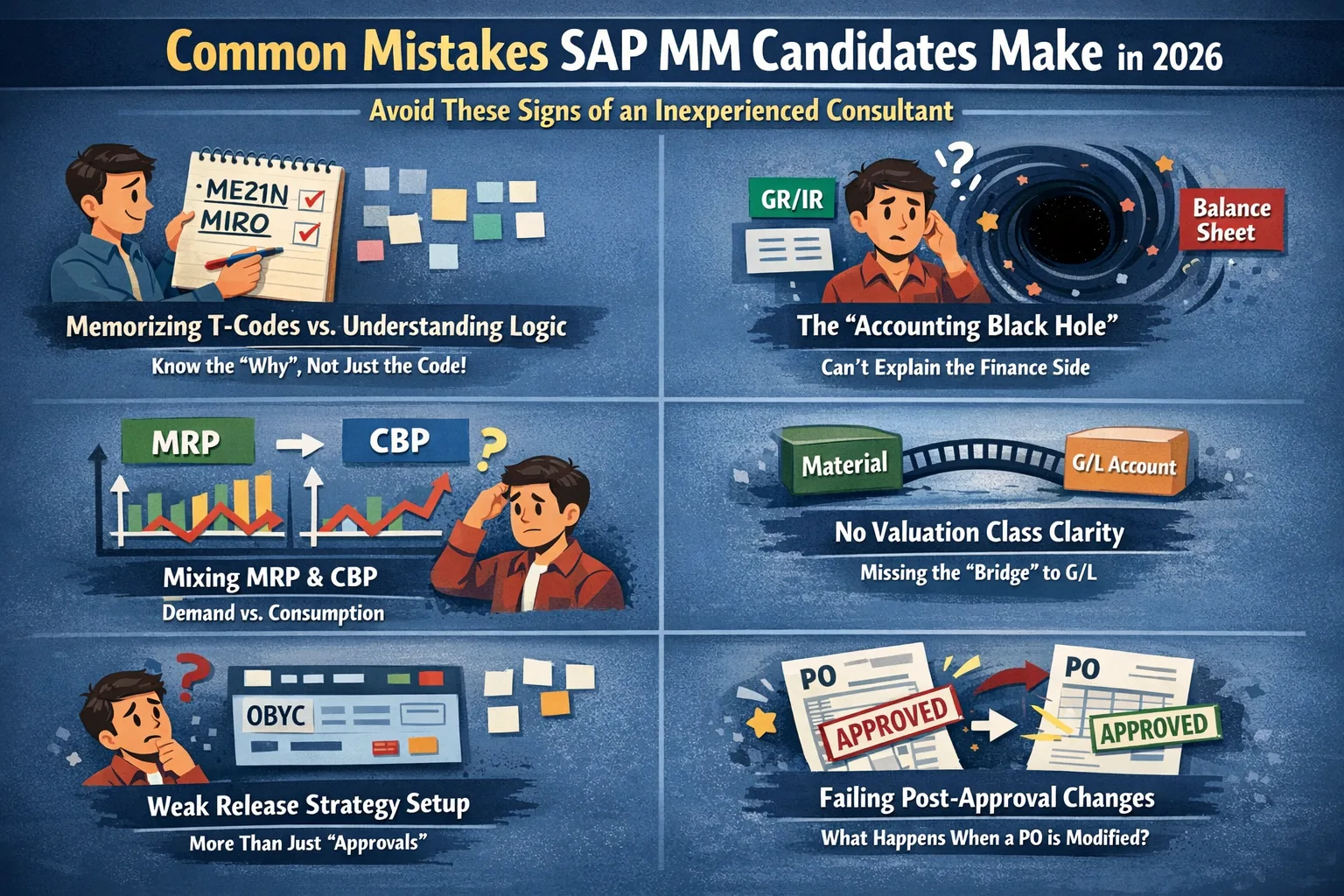
In 2026, recruiters are filtering out “paper consultants” faster than ever. If you want to build credibility, avoid these common pitfalls that scream “inexperienced”:
- Memorizing T-codes instead of Logic: Knowing ME21N or MIRO is basic. An interviewer doesn’t care if you know the code; they care if you know why a specific field in that transaction affects the downstream process.
- The “Accounting Black Hole”: Many candidates explain the procurement process perfectly but freeze when asked about the Accounting Entry. If you don’t understand the relationship between the GR/IR Clearing account and the Balance Sheet, you aren’t ready for a consultant role.
- Confusing MRP and CBP: Beginners often treat Material Requirements Planning (MRP) and Consumption-Based Planning (CBP) as the same thing. One is based on future demand (PIRs), the other on historical consumption. Mixing these up shows a lack of fundamental planning knowledge.
- No Clarity on Valuation Class: The Valuation Class is the “bridge” between the Material and G/L accounts. If you can’t explain how the system picks a G/L account via the Valuation Class and Account Category Reference, your OBYC knowledge is superficial.
- Weak Release Strategy Configuration: Don’t just say “it’s for approvals.” You must understand Characteristics, Classes, and Check Groups. Most candidates fail to explain what happens when a PO is modified after it has already been approved.
How to Prepare for SAP MM Interviews: Your Action Plan
Preparation isn’t about reading a 500-page PDF. It’s about building a mental “map” of the system. Follow this 5-step roadmap:
- Master the End-to-End P2P Flow: Don’t just look at SAP; look at the business. Why does a company need a Quota Arrangement? Why would they choose Subcontracting over local purchase?
- Deep-Dive into SPRO Paths: Open your SAP sandbox and navigate the backend. You should be able to visualize exactly where to go in the Implementation Guide (IMG) to define a new Purchase Organization or a Pricing Schema.
- Bridge the FI-MM Gap: Spend 48 hours focusing purely on Integration. Study how the Valuation Class, Movement Type, and Transaction Keys (BSX, WRX, PRD) interact. This is the “Consultant Tier” of knowledge.
- Practice in the Sandbox: Theory is useless without muscle memory. Configure a full Release Strategy with Workflow from scratch. If you hit an error, don’t Google the answer immediately, debug the configuration yourself.
- Prepare 3 War Stories: Interviewers love real-time project examples. Prepare three scenarios:
- A time you solved a complex configuration error.
- How you handled a “Price Variance” issue during Invoice Verification.
- A specific S/4HANA migration challenge you understood (e.g., moving to Business Partners).
Conclusion
SAP MM interviews are no longer a test of your memory, they are a test of your troubleshooting confidence. In a market where everyone has a certification, the person who gets hired is the one who can explain the business impact of a technical configuration.
If you can walk into a room and clearly explain the accounting impact of a Goods Receipt, the logic behind a complex pricing schema, and how to resolve a stuck release strategy, you are already ahead of 80% of other candidates.
Stop studying definitions. Start solving processes.
Frequently Asked Questions
1) What are the most important topics to prepare for an SAP MM interview?
For an SAP MM interview, I always focus on the Procure-to-Pay (P2P) cycle, FI-MM integration, pricing procedure, release strategy configuration, MRP basics, and common troubleshooting scenarios like account determination errors and invoice blocks. Interviewers test practical understanding more than theory.
2) How can I prepare for scenario-based SAP MM interview questions?
I recommend revising real-time issues such as pricing not picking in PO, MRP not generating PR, invoice blocked due to variance, and GR account errors. Practicing configuration paths (SPRO) and understanding accounting entries helps answer confidently in interviews.
3) What accounting entries should an SAP MM consultant know?
An MM consultant must clearly explain accounting entries for Goods Receipt (Inventory Dr / GR-IR Cr), Invoice Verification (GR-IR Dr / Vendor Cr), and consumption posting for non-stock materials. Understanding OBYC configuration is very important.
4) What is the difference between SAP MM in ECC and S/4HANA?
In S/4HANA, Vendor Master is replaced by Business Partner, Material Ledger is mandatory, and many classic transactions are replaced by Fiori apps. The data model is simplified, but core P2P concepts remain the same.
5) Do interviewers expect SAP MM consultants to remember transaction codes?
In my experience, interviewers do not focus heavily on memorizing T-codes. They expect strong understanding of business processes, integration logic, configuration concepts, and troubleshooting ability rather than just navigation knowledge.