.jpg)

















Oil Price Impact on Indian Economy: The 2026 Middle East Oil Surge







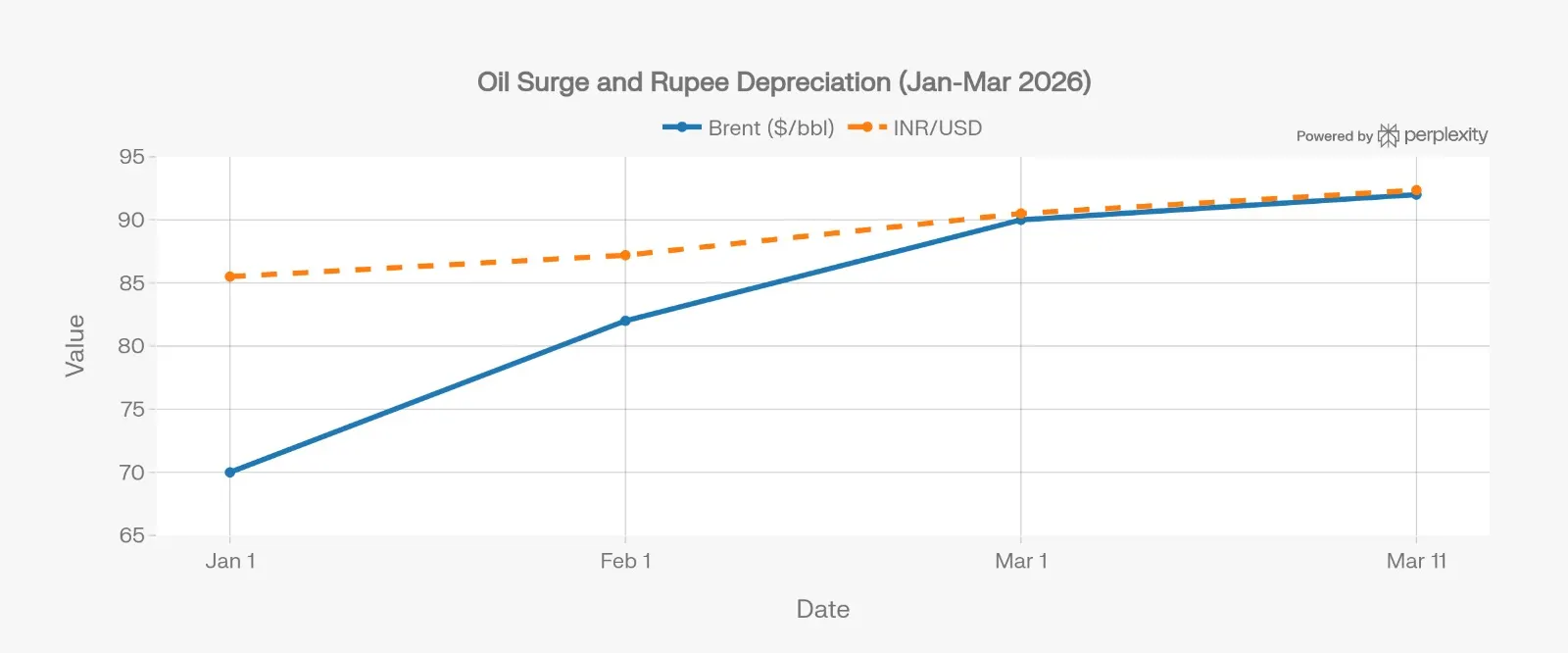
India’s economic exposure to geopolitical shocks in the Middle East has resurfaced as a major policy concern in 2026. With Brent crude trading near $95 per barrel amid escalating tensions between Iran and Israel, the risk premium embedded in global oil prices is rising once again.
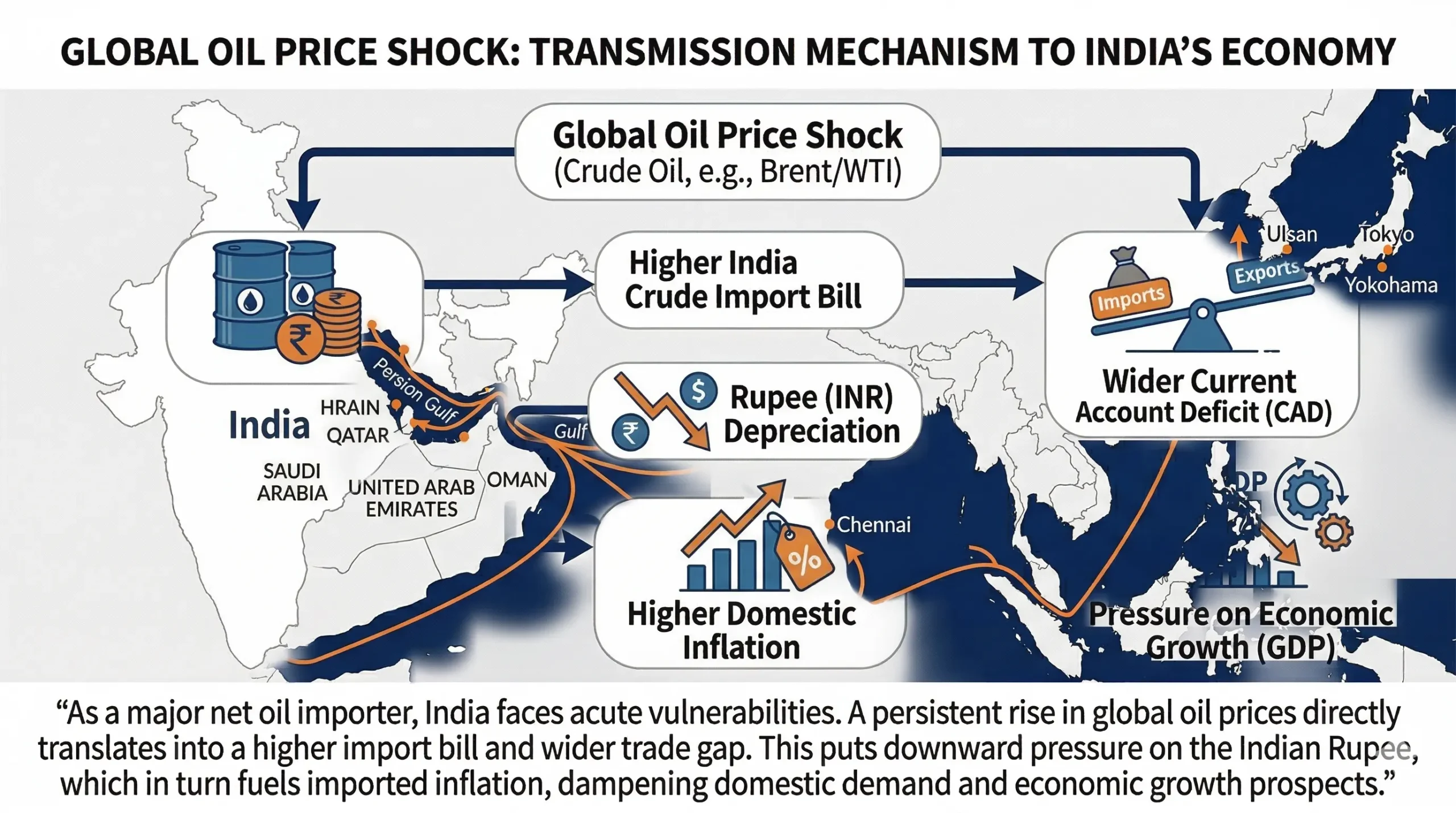
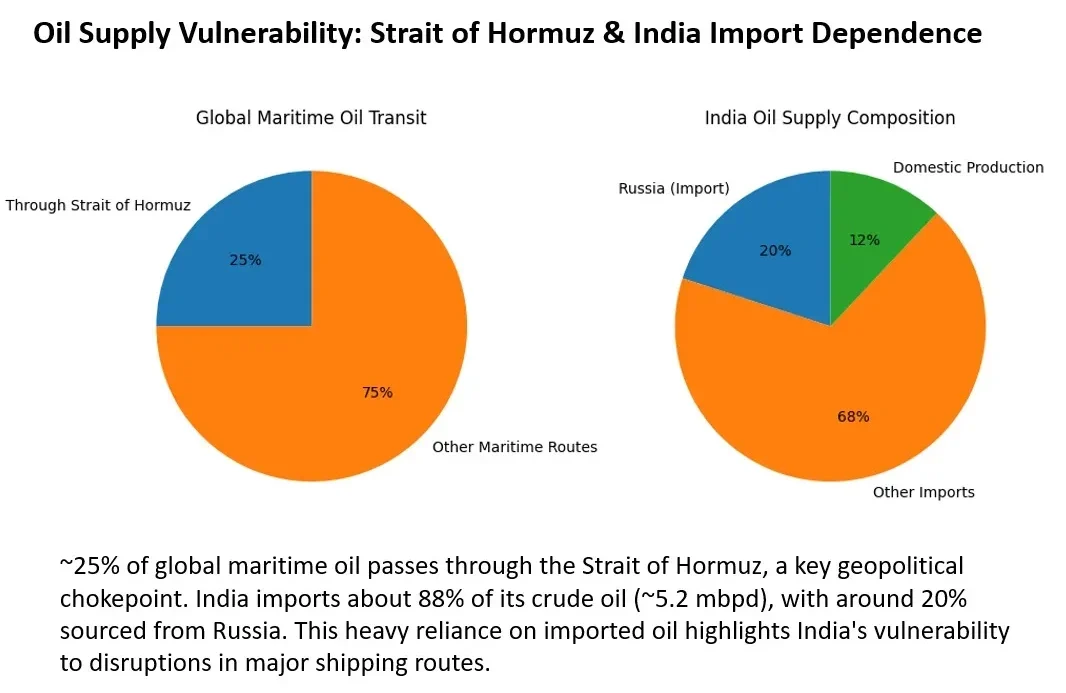
For a country that imports nearly 88-89% of its crude oil requirements, even moderate price spikes carry significant macroeconomic consequences. The oil price impact on Indian economy is felt almost immediately as higher crude prices inflate the national import bill and widen the current account deficit. This surge in dollar outflows places significant downward pressure on the rupee, creating a ripple effect that touches every fiscal metric from inflation to GDP growth.
Economists often refer to this geopolitical risk component in oil prices as the Middle East Premium. It reflects the additional cost markets assign to crude when supply disruptions become more likely due to conflict, sanctions, or threats to key shipping routes in the Persian Gulf.
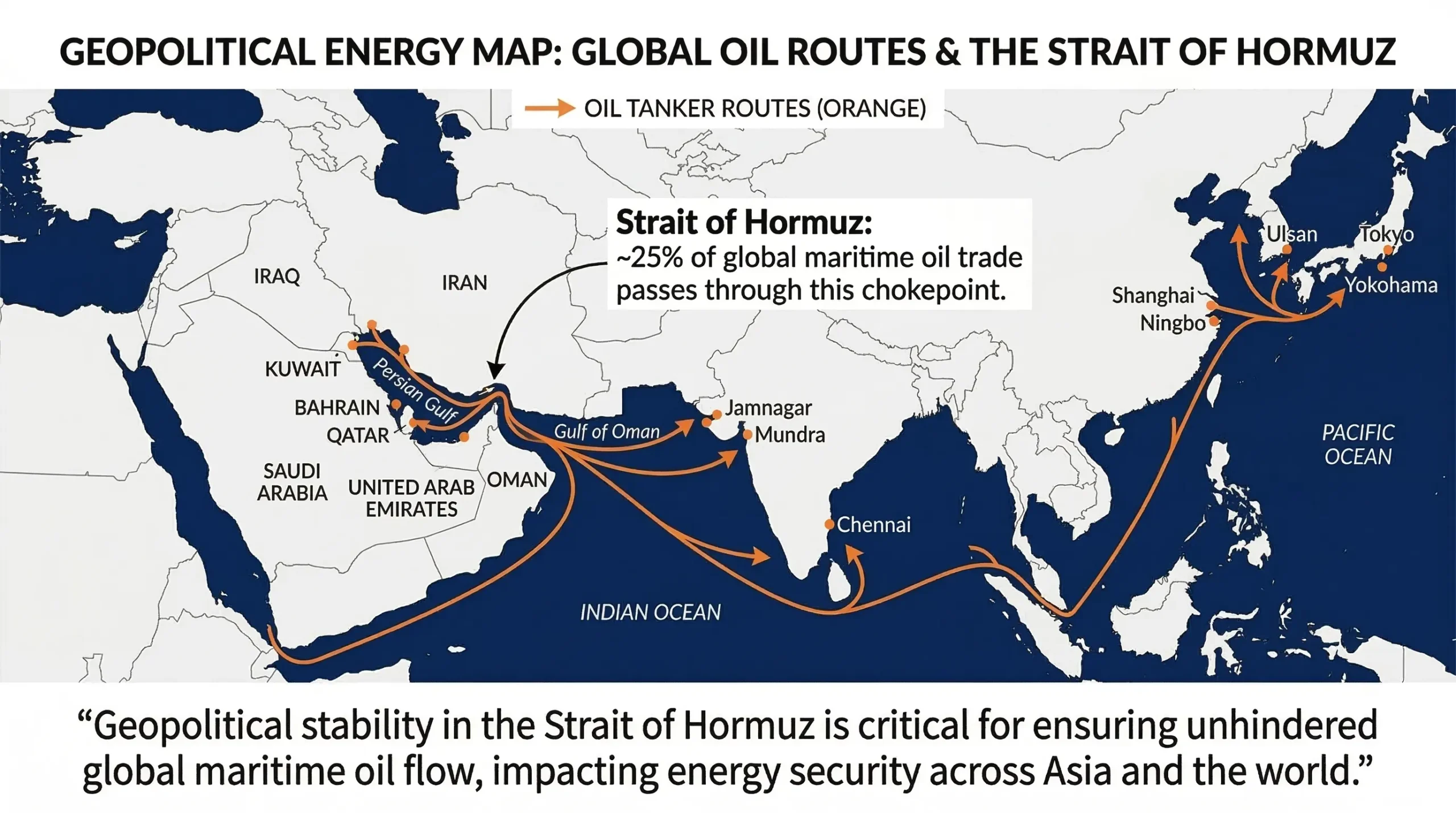
The concern is not merely theoretical. Roughly one-fifth of global oil consumption flows through the strategically critical Strait of Hormuz. Any escalation in military tensions in the region immediately increases the probability of supply disruptions, forcing global markets to price in a geopolitical risk buffer.
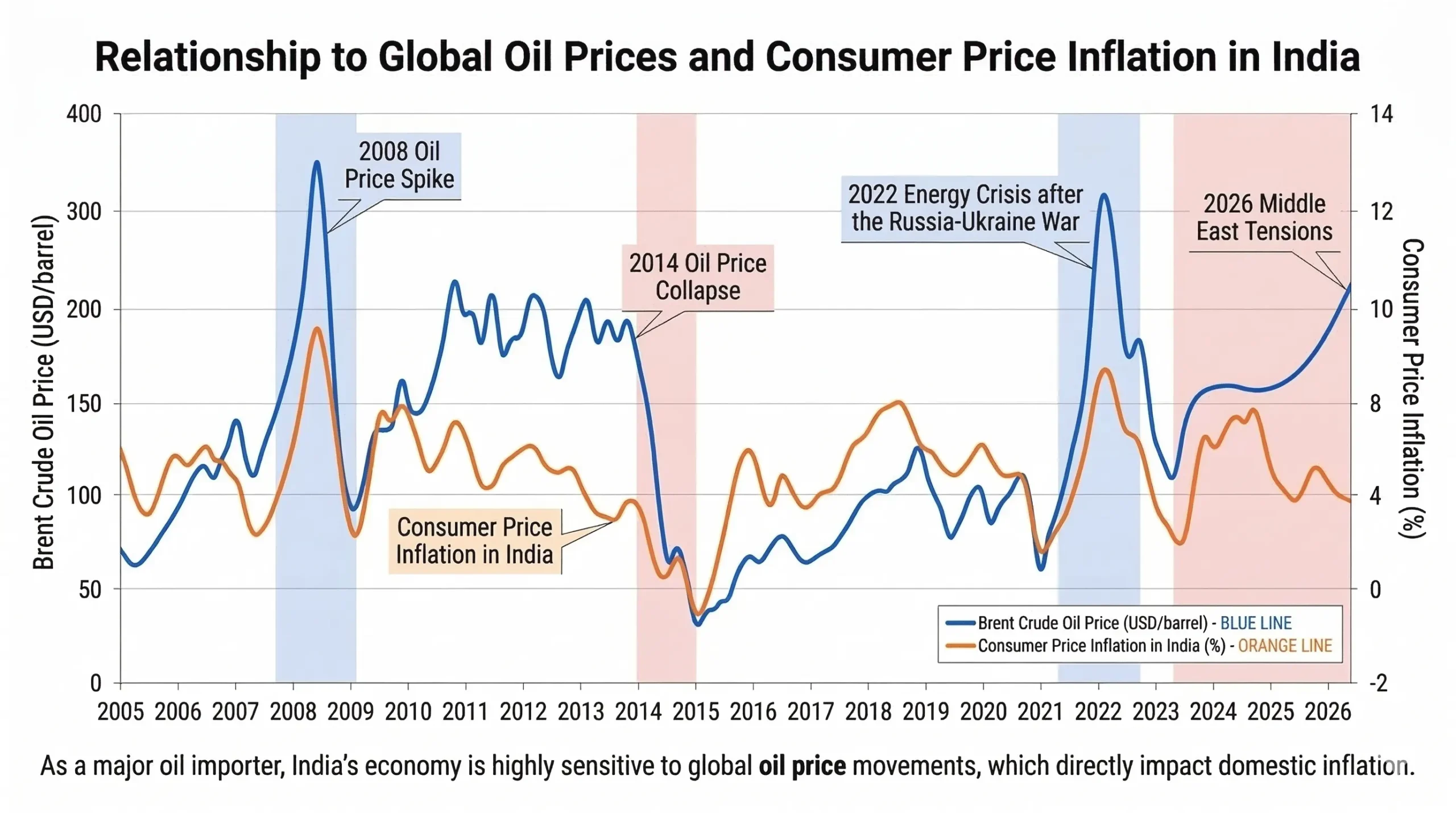
For India, the economic consequences of such shocks extend far beyond fuel prices. Rising crude costs influence inflation, currency stability, fiscal balances, and industrial production, making oil volatility one of the most important external risks facing the Indian economy.
Table of Contents
- Why Middle East Conflicts Raise Oil Prices
- How Rising Oil Prices Affect India’s Economy
- Sectoral Impact of Rising Oil Prices on India
- The Crisis at the Kitchen Table: LPG and Cooking Gas Supply
- The Russian Pivot 2.0: A Buffer Without the Bargain
- What India Is Doing to Reduce Oil Dependence
- Conclusion
- Frequently Asked Questions
Why Middle East Conflicts Raise Oil Prices
Understanding the Middle East Premium requires looking at the region not just as a map, but as a massive energy lung. When that lung constricts, the world gasps for air.
1. The Chokepoint Theory: The Strait of Hormuz
The most significant reason why oil prices rise during war is the vulnerability of shipping lanes. The Strait of Hormuz is a narrow waterway through which nearly 20-27% of global petroleum liquid consumption passes. In the current 2026 conflict, any military posturing near this strait triggers an immediate fear tax. Traders begin pricing in the possibility of a total blockade, which could theoretically send prices toward $150 per barrel.
2. The Risk of Infrastructure Damage
Modern warfare involves precision strikes. The 2026 surge is fueled by fears that oil refineries, desalination plants, and loading terminals in the Persian Gulf could become collateral damage. If a major processing plant goes offline, the global supply-demand balance tilts instantly into a deficit.
3. Increased Insurance and Freight Costs
Conflict doesn’t just stop oil; it makes moving it expensive. War-risk insurance premiums for tankers operating in the Gulf have reportedly surged by over 400% during March 2026, according to shipping industry estimates. These costs are ultimately passed along the supply chain and embedded in the landed price of crude imports.
How Rising Oil Prices Affect India’s Economy
India is the world’s third-largest consumer of oil, importing roughly 88% of its total requirement. This massive dependency creates a direct “umbilical cord” between West Asian stability and Indian prosperity.
The Macroeconomic Domino Effect
When we analyze how oil prices affect Indian economy, we see a sequence of events that impacts the nation’s financial health:
1. Current Account Deficit (CAD)
India imports nearly 5 million barrels of crude oil per day. A $10 increase in oil prices can raise the country’s annual import bill by about $17–18 billion, widening the current account deficit by roughly $12–15 billion after adjustments.
2. Rupee Depreciation
Higher oil prices increase India’s demand for US dollars, putting pressure on the rupee. The impact can intensify when global investors pull capital from emerging markets. The rupee briefly weakened to around ₹92.40 per dollar in March 2026.
3. Fiscal Pressure
The government faces a difficult choice: pass higher fuel costs to consumers, which increases inflation, or reduce fuel taxes, which lowers government revenue and widens the fiscal deficit.
Sectoral Impact of Rising Oil Prices on India
The crude oil price shock does not affect all sectors of the Indian economy equally. Instead, the impact spreads through multiple transmission channels, fuel costs, logistics expenses, input prices, and consumer demand. Industries with high energy dependency or transportation intensity experience the fastest margin compression.
Aviation: Immediate Cost Shock
Among the most vulnerable sectors is aviation. Aviation turbine fuel (ATF) accounts for roughly 35–40% of airline operating costs in India.
When crude prices rise, ATF prices increase almost immediately, forcing airlines to either raise ticket prices or absorb losses. Higher fares often suppress passenger demand, particularly in price-sensitive domestic markets.
As a result, airlines operating in India, such as IndiGo and Air India, face pressure on profitability whenever oil prices spike.
Take the first step toward a finance career with real-world stock market skills.Get trained by NISM Certified Professionals In Kolkata |
|
| Financial Market Course | |
| More Learning Options for you: Stock Market Course In Kolkata | |
Logistics and Transportation: Rising Freight Costs
The transportation sector is another major transmission channel for oil shocks. Diesel is the dominant fuel used in India’s trucking industry, which moves nearly 65–70% of the country’s freight.
When diesel prices increase:
- Trucking companies raise freight charges
- Logistics costs rise for manufacturers and retailers
- Supply chains become more expensive
This cost escalation ultimately feeds into higher consumer prices, particularly for goods transported across long distances such as agricultural produce and construction materials.
FMCG and Consumer Goods: Margin Compression
Fast-moving consumer goods companies operate on thin margins and rely heavily on transportation and packaging inputs derived from petroleum.
Companies like Hindustan Unilever and ITC Limited experience a double impact:
- Rising logistics costs
- Higher prices for petrochemical-based packaging materials
To protect profitability, firms typically respond by either reducing product quantities (shrinkflation) or gradually increasing retail prices.
Fertilizer and Agriculture: Hidden Energy Link
Agriculture is indirectly linked to crude oil prices through fertilizer production and farm logistics.
Natural gas and petroleum derivatives are key inputs in fertilizer manufacturing, particularly for nitrogen-based fertilizers. Higher global energy prices increase fertilizer production costs, which can lead to either higher subsidy burdens for the government or higher costs for farmers.
Since agriculture supports nearly half of India’s workforce, sustained energy shocks can indirectly affect rural incomes and food prices.
Petrochemicals and Refining: Mixed Impact
India’s large refining sector experiences a more complex effect from oil price volatility.
Companies such as Reliance Industries and Indian Oil Corporation benefit when refining margins expand during periods of supply disruption. However, extreme volatility can also disrupt planning and increase working capital requirements.
India has partially insulated itself from global price shocks by diversifying its crude imports following the 2022 Russia-Ukraine War, significantly increasing discounted purchases from Russia.
| Sector | Impact Level | Primary Reason | Key Stat |
|---|---|---|---|
| Aviation | Extreme | Fuel 35-40% costs; surcharges imposed | ATF hikes prompt Air India fees |
| Logistics | High | Diesel ~₹90-97/L nationwide | Trucking fuel dependency 65-70% |
| Renewables | Positive | Faster ROI on solar/EV | Oil surge accelerates shift |
The Crisis at the Kitchen: LPG and Cooking Gas Supply
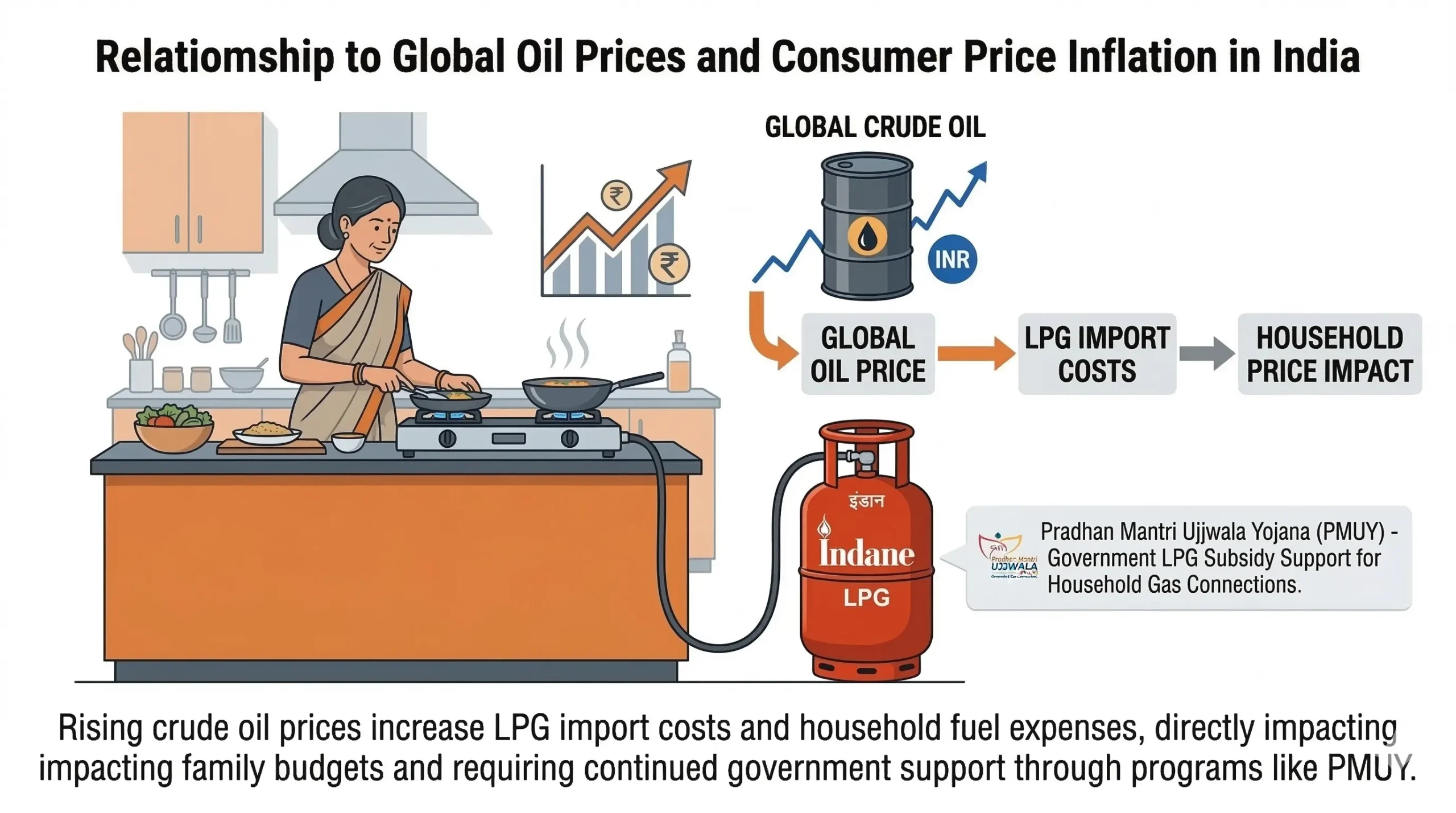
While crude oil dominates the headlines, a more intimate crisis is unfolding in Indian kitchens. The ongoing conflict has severely disrupted India’s LPG (Liquefied Petroleum Gas) imports. Because 80–90% of India’s supply, meeting over 60% of total domestic demand, originates from Gulf nations like Saudi Arabia, Qatar, and the UAE, any disruption in the Strait of Hormuz is felt instantly.
Immediate Impact on Households and Businesses
- Price Hikes: Domestic cylinders have jumped by ₹60, reaching ₹913 in Delhi. Commercial cylinders have seen an even steeper rise of ₹114–₹115.
- Supply Shortages: Major cities like Mumbai, Bengaluru, and Kolkata are reporting irregular deliveries. This has sparked panic buying and long queues at gas agencies.
- New Restrictions: To curb hoarding, a 25-day inter-booking rule has been implemented, limiting how frequently a household can order a refill.
The Government Response
To manage this volatility, the Indian government has invoked the Essential Commodities Act. Domestic refineries have been directed to prioritize household LPG production. Currently, fertilizer and other key sectors have been restricted to a 70% allocation to ensure homes stay fueled. Furthermore, sourcing has been expanded to 40 different countries to mitigate the heavy reliance on the Gulf.
The Russian Pivot 2.0: A Buffer Without the Bargain
In a dramatic diplomatic turn this week, the US issued a 30-day waiver allowing Indian refiners to ramp up purchases of Russian Urals crude. This is a strategic attempt to offset Middle East shortages. However, the Russian Pivot of 2026 is far more expensive than the 2022 version.
The Catch: The Vanishing Discount
While this pivot offers a necessary logistical buffer, the deep discounts once seen (often $15–$20 per barrel) have evaporated.
- The Premium: Due to high global demand and massive competition for non-Gulf oil, Indian refiners are now paying a $2–$4 premium over Brent for Russian crude.
- Insurance Costs: Increased shipping risks have inflated insurance premiums, further eating into any remaining cost advantage.
Few related topics for your knowledge
What India Is Doing to Reduce Oil Dependence
The 2026 crisis has accelerated India’s Energy Independence roadmap. The government is no longer treating green energy as a choice, but as a national security imperative.
1. Diversifying Oil Imports
After disruptions caused by the 2022 Russia-Ukraine War, India increased discounted crude purchases from Russia. Major refiners like Reliance Industries and Indian Oil Corporation expanded imports to lower the overall cost of crude and maintain supply stability.
2. Expanding Strategic Petroleum Reserves (SPR)
India has built massive underground salt caverns in Visakhapatnam, Mangalore, and Padur. These reserves act as a buffer that can power the country for roughly 9.5 days during a total supply cutoff. Plans are currently underway to double this capacity by 2028.
3. Accelerating the Green Transition
The most sustainable way to reduce the oil price impact on the Indian economy is to stop using oil.
- Ethanol Blending: India has achieved a 15% ethanol blending target in petrol, with a goal of 20% by next year.
- EV Adoption: Aggressive subsidies for electric two-wheelers aim to reduce the daily demand for petrol and diesel by millions of barrels by 2030.
Conclusion
The 2026 Middle East Premium is a stark reminder that India’s economic heart beats in sync with global geopolitics. The current oil price impact on Indian economy is undeniable, it strains the Rupee, fuels inflation, and tests the resilience of the middle class.
However, every crisis is a catalyst. This surge is forcing a faster transition to solar, wind, and green hydrogen. Until India can truly de-link its growth from the price of a barrel in the Persian Gulf, it remains a passenger on a volatile geopolitical ride.
Frequently Asked Questions
1. What is the current oil price impact on the Indian economy in 2026?
The impact is seen through imported inflation. As crude prices approach $100, the Indian Rupee weakens, and the cost of essential goods, from groceries to electronics, rises due to increased transportation costs.
2. How exactly do rising oil prices affect the Indian economy on a daily basis?
It manifests as higher petrol and diesel prices at the pump. For the government, it leads to a wider trade deficit and puts pressure on the RBI to increase interest rates, making home and business loans more expensive.
3. Why do Middle East conflicts cause such a sharp Middle East conflict impact on oil prices?
The Middle East produces about one-third of the world’s oil. Conflicts create supply anxiety, where traders fear that production facilities or shipping routes (like the Strait of Hormuz) might be damaged or closed.
4. Why do oil prices rise during war even if production hasn’t stopped yet?
This is due to speculative pricing. Markets look ahead; if there is a risk that a major oil field might be bombed, traders buy oil now to protect themselves, which drives the price up immediately.
5. What is the long-term solution for the crude oil price impact on India?
The solution is a multi-pronged energy strategy: increasing ethanol blending, transitioning to electric vehicles (EVs), investing in Green Hydrogen, and diversifying oil imports away from a single geographic region.

- Nobody’s Talking About These Basic Computer Skills For Beginners - September 11, 2026
- The GST Return Filing Course That Could Save Your Career - September 5, 2026
- Source List in SAP MM: Why Every Interviewer Asks This - August 28, 2026