.jpg)
















Skipping the Consignment Process in SAP MM Could Cost You Your Next SAP Job







Quick Answer
The consignment process in SAP MM allows a vendor to store goods at the buyer’s premises without immediate payment, the buyer pays only when the goods are consumed. It involves four main types, specific T-codes like ME21N and MRKO, and differs significantly from subcontracting in SAP.
Picture this: You’re sitting in a job interview for an SAP MM consultant role. Everything is going great until the interviewer leans forward and asks, “Can you walk me through the consignment process in SAP MM?” Your mind goes blank. You know you studied it. You know it’s important. But you can’t connect the dots in real time.
If that scenario made your stomach drop a little this post is exactly for you.
Whether you’re a fresher who just enrolled in an SAP course, a finance or supply chain professional looking to upskill, or someone mid-career wanting to switch into ERP consulting, understanding the consignment process in SAP MM is one of those foundational concepts that will keep coming up. In interviews, in projects, and in daily operational work.
Let’s break it down clearly, practically, and without drowning you in jargon.
Table of Contents
- What Is a Consignment in SAP?
- What Are the 4 Types of Consignment?
- What Is the Consignment Process in SAP MM?
- What Is the T-Code for the Consignment Process?
- What Is the T-Code for Consignment Stock in SAP?
- What Are the Methods of Consignment? / How Does Settlement Work?
- What Is the Difference Between Subcontracting and Consignment in SAP MM?
- A Real-World Scenario: How Consignment Saves a Factory Floor
- The Bottom Line
- Frequently Asked Questions
What Is a Consignment in SAP?
Definition
Consignment in SAP is a procurement process where a vendor delivers goods to the buyer’s warehouse or plant, but the ownership of the goods remains with the vendor until the buyer actually withdraws or uses those goods. Payment is triggered only at the point of consumption not delivery.
Think of it like this: Your vendor is basically saying, “Here, keep my goods in your warehouse. Use them as you need. You’ll pay me only when you actually use them.”
This is a powerful arrangement for buyers; it reduces working capital, eliminates the risk of overstocking, and ensures smooth production flow. For vendors, it’s a way to keep their products accessible and close to the customer.
In SAP Materials Management (SAP MM), this entire lifecycle from ordering to goods receipt to payment is managed with a defined set of steps and transaction codes.
What Are the 4 Types of Consignment?
In the context of SAP MM and supply chain management, consignment can take four primary forms depending on the direction of goods flow and the nature of the business relationship:
Vendor Consignment
Vendor stores goods at buyer’s premises. Most common in SAP MM procurement cycles.
Customer Consignment
The company stores its goods at the customer’s site. Used in SAP SD (Sales & Distribution).
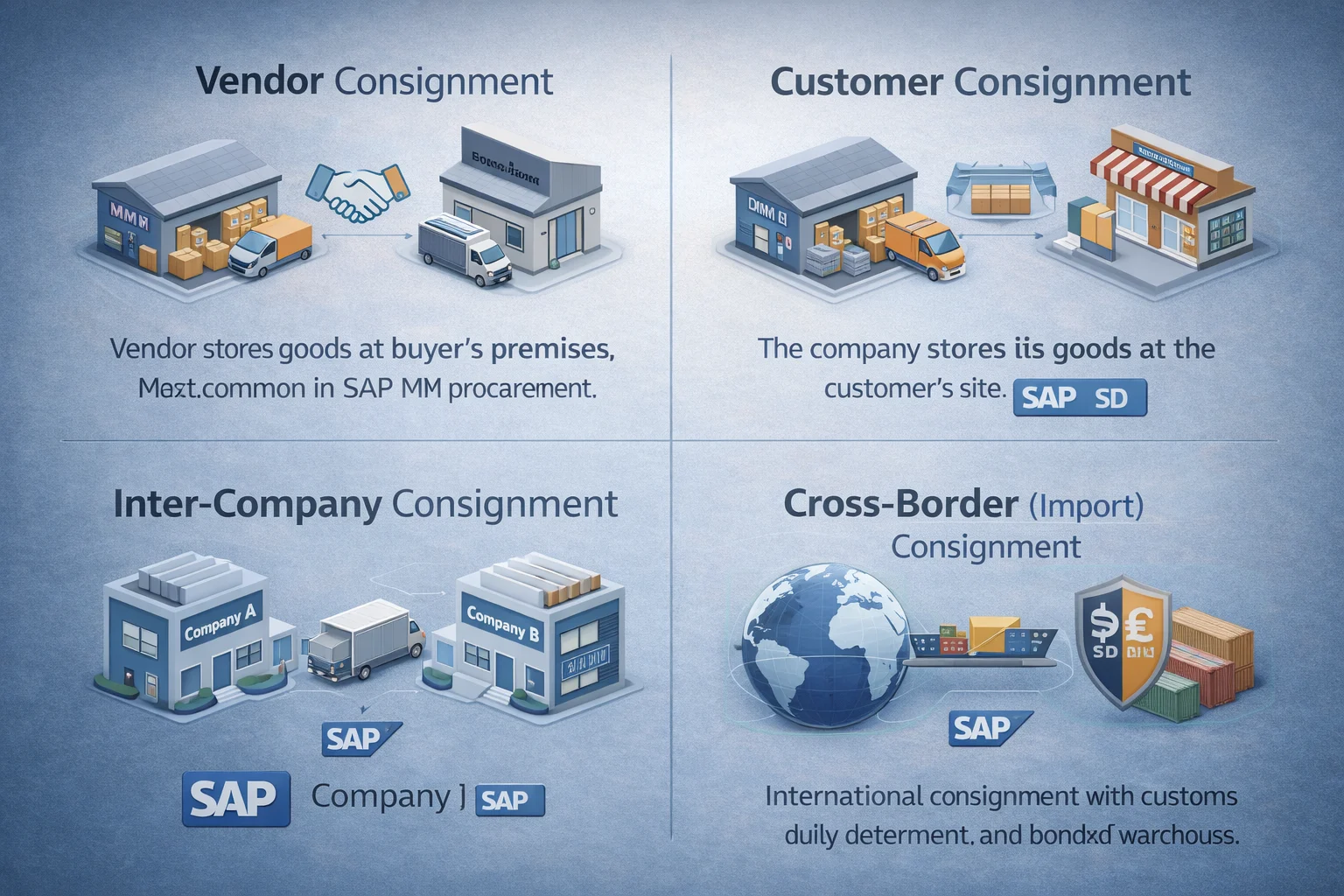
Inter-Company Consignment
Goods transferred between sister companies within the same SAP system or group.
Cross-Border (Import) Consignment
International consignment with customs, duty deferment, and bonded warehouse rules.
Pro Tip for Students
In most SAP MM interviews and certification exams, Vendor Consignment is the focus. Master it first, then explore the others for a broader picture.
What Is the Consignment Process in SAP MM?
The consignment process in SAP MM follows a clear, structured workflow. Here’s how it plays out in real business scenarios:
1. Create a Consignment Purchase Order (PO)
You raise a PO with item category ‘K’ (Konsignation) in SAP. This tells the system: This is a consignment arrangement.
T-code: ME21N
2. Goods Receipt (GR) No Invoice Yet
When the vendor delivers goods, you post a Goods Receipt using MIGO. The stock lands in your plant as Vendor Consignment Stock, special stock type ‘K’. Crucially, no Financial Accounting entry is posted here because you don’t own the stock yet.
3. Goods Withdrawal / Transfer to Own Stock
When production or operations consume the consignment goods, a withdrawal is posted via MIGO (movement type 201 or 261). This is the ownership transfer moment, the stock moves from vendor-owned to company-owned.
4. Consignment Settlement (Payment to Vendor)
SAP automatically calculates liability based on the withdrawn quantities. The settlement is done using T-code MRKO, which creates the invoice and posts the accounting entry, now you owe the vendor money.
5. Return of Unsold Consignment Goods
If you want to return unused goods to the vendor, you use a return delivery in MIGO with movement type 122K. No liability is created for returned goods.
Key Concept to Remember
The Golden Rule of Consignment in SAP: Goods receipt ≠ Payment trigger. Goods withdrawal = Payment trigger. This is what makes consignment fundamentally different from standard procurement.
What Is the T-Code for the Consignment Process?
Transaction codes (T-codes) are the shortcuts that SAP professionals live by. Here are the essential T-codes you must know for the consignment process in SAP MM:
ME21N: Create Consignment Purchase Order (Item Category K)
ME22N: Change/Edit Consignment Purchase Order
ME23N: Display Consignment Purchase Order
MIGO: Goods Receipt & Goods Withdrawal for Consignment Stock
MRKO: Consignment & Pipeline Settlement (Payment Trigger)
MB58: Display Consignment Stock Overview per Vendor
ME2K: Purchase Orders by Account Assignment (Consignment)
MBGR: Display Material Documents (Consignment movements)
Rule the Market with Professional SAP Training |
|||
| SAP Certification Courses | |||
| Explore All SAP Courses SAP FICO Course | SAP MM Course | SAP PP Course | SAP SD Course |
|||
What Is the T-Code for Consignment Stock in SAP?
To view and monitor consignment stock in SAP MM, these are the most-used T-codes:
MB58: Shows consignment stock by vendor and material. This is your go-to for a quick overview of what stock exists at your plant under vendor ownership.
MMBE: Stock Overview. This will show consignment stock under the “Special Stocks” tab with stock type ‘K’.
MB51: Material Document List. Filter by movement types 101K, 201K, 261K to trace all consignment movements.
ME2K: Displays all POs relevant to consignment, filterable by plant, vendor, and material.
Interview Insight
Interviewers frequently ask: Where does consignment stock appear in MMBE?
The answer: Under Special Stocks → Vendor Consignment → Stock Type K.
Knowing this shows practical system knowledge, not just theoretical understanding.
What Are the Methods of Consignment? / How Does Settlement Work?
Once you understand what consignment is, the next question is: how and when does the vendor actually get paid? In SAP MM, there are two primary methods of consignment settlement:
Method 1: Automatic Settlement via MRKO
This is the standard SAP-recommended method. When you run MRKO, SAP automatically:
- Identifies all unconsolidated consignment withdrawals (goods that were used but not yet invoiced)
- Creates an invoice document for the withdrawn quantity × info record price
- Posts the FI accounting entry: Debit → Inventory/Consumption Account | Credit → Vendor Account (GR/IR)
Method 2: Manual/Periodic Settlement
Some companies batch their consignment settlements, weekly or monthly rather than settling after every withdrawal. This is a business process choice managed through the MRKO transaction with date filters. It simplifies reconciliation for high-volume consignment scenarios.
Common Mistake to Avoid
Beginners often confuse the Goods Receipt posting with triggering payment. In standard procurement (PO → GR → Invoice), GR creates a liability. In consignment, it does not. Payment is triggered only by withdrawal + MRKO settlement. This distinction is critical in exams and interviews.
What Is the Difference Between Subcontracting and Consignment in SAP MM?
This is one of the most commonly asked SAP MM interview questions and for good reason. Both involve external vendors and special stock types, which causes confusion. Here’s a clear comparison:
| Parameter | Consignment (Item Cat. K) | Subcontracting (Item Cat. L) |
|---|---|---|
| Core Concept | Vendor stores goods at buyer’s premises; buyer pays only upon use | Buyer provides raw materials to vendor; vendor processes & returns finished goods |
| Who Owns the Stock? | Vendor (until withdrawal) | Buyer (even when at vendor’s site, it’s stock with vendor) |
| Material Flow Direction | Vendor → Buyer’s plant | Buyer (even when at vendor’s site, it’s stock with vendor) |
| Key T-code for PO | ME21N (Item Cat. K) | ME21N (Item Cat. L) |
| Payment Trigger | Goods withdrawal + MRKO settlement | Goods receipt of finished product |
| Special Stock Type | ‘K’ – Vendor Consignment | ‘O’ – Stock with Subcontractor |
| GR/IR Clearing | At settlement via MRKO | At goods receipt (standard GR/IR) |
| Real-World Example | A car manufacturer letting a tire company store tires at their plant | A garment company sending fabric to a tailor to stitch and return garments |
A Helpful Memory Trick
Consignment = Vendor stores for you
Subcontracting = You send material, and the vendor works for you
Ready to Master SAP MM, Not Just Read About It?
Reading a blog is a great first step. But actually getting hired as an SAP MM consultant requires hands-on system practice, real project exposure, and interview-ready knowledge.
That’s exactly what ICA Edu Skills delivers. As one of India’s most trusted SAP training institutes, ICA Edu Skills bridges the gap between textbook concepts and live SAP environments so you walk into your first day on the job actually knowing what to do.
- Live SAP system access practice consignment, subcontracting, and every other MM process
- Industry-experienced trainers with real consulting backgrounds
- Dedicated placement assistance with top IT and consulting firms
- Structured curriculum aligned with SAP S/4HANA certification syllabus
- Batch timings flexible for working professionals and full-time students
- Resume building and mock interview sessions included
A Real-World Scenario: How Consignment Saves a Factory Floor
Let’s bring this to life. Imagine you’re the Materials Manager at a mid-size auto-components manufacturer in Pune. Your production line uses industrial fasteners thousands of them, daily.
Under a standard purchase order, you’d have to:
- Forecast months in advance
- Pay for a large batch upfront
- Risk overstocking (cash stuck in inventory) or understocking (production stops)
Under a consignment arrangement in SAP MM, your vendor stores fasteners in your warehouse. Your team withdraws exactly what production needs, daily. At month-end, you run MRKO and pay only for what was consumed. Your working capital stays fluid, your vendor stays close, and your line never stops.
This is why consignment is a preferred procurement strategy in manufacturing, pharmaceuticals, automotive, and FMCG sectors and why SAP MM professionals who understand it deeply are in demand.
Few SAP related topics for your knowledge
- Accounts Receivable Process In SAP:A Step-by-Step Process
- SAP FICO Enterprise Structure: A Comprehensive Guide
- Accounts Payable Process in SAP: Step by Step Guide
- Vendor Reconciliation in SAP: Definition, Steps, Scenario, Advantages
- SAP Order To Cash Process: Optimizing Financial Flows
- 25+ SAP MM Interview Questions & Answers: Cheat Sheet You Need Today
The Bottom Line
The consignment process in SAP MM is more than a procurement technique; it’s a smart business strategy encoded into one of the world’s most powerful ERP systems. Once you understand the flow (PO → GR → Withdrawal → Settlement), the T-codes (ME21N, MIGO, MRKO, MB58), the four types, and how it differs from subcontracting, you have a genuinely useful skill that employers value.
Don’t just aim to pass a certification. Aim to understand the why behind every step. That’s what separates good consultants from great ones.
If you want to go from understanding to actually doing, get into a live SAP system and practice these flows until they’re second nature.
Frequently Asked Questions
1. What is the consignment process in SAP MM in simple terms?
A vendor stores goods at your warehouse, but you pay only when you use them. Ownership stays with the vendor until withdrawal. Managed via item category ‘K’ in PO; settled using T-code MRKO.
2. What is the difference between consignment and standard purchasing in SAP MM?
In standard purchasing, GR creates immediate payment liability. In consignment, GR posts no accounting entry, payment triggers only on goods withdrawal and MRKO settlement. More cash-flow friendly.
3. What is the T-code for consignment settlement in SAP?
The T-code for consignment settlement in SAP MM is MRKO. It invoices all unconsolidated withdrawals and posts the accounting entry to the vendor’s account. Usually run weekly or monthly.
4. Can I return consignment goods to be a vendor in SAP?
Yes. Use T-code MIGO with movement type 122 to return unused consignment stock. Since ownership is never transferred, no payment obligation is created and vendor stock is simply reduced.
5. Is learning the consignment process important for an SAP MM certification?
Absolutely. It’s a core topic in SAP MM, appearing in theory, scenario, and practical questions. It’s also one of the most frequently asked subjects in SAP MM job interviews.

- Skipping the Consignment Process in SAP MM Could Cost You Your Next SAP Job - April 10, 2026
- No Job After B.Com? What to Do to Get Hired in 2026 - April 3, 2026
- Unemployment Rate in India 2026: Why Graduates are Struggling - March 23, 2026